About the treatment
A wart is something your own skin has been told to build
Understanding that one point explains almost everything else on this page — why the creams are slow, why the shape keeps coming back if only the top is taken off, and why we treat each one separately rather than sweeping across an area.
A wart is not a foreign body that has landed on you and can be lifted away. It is skin. A virus in the human papillomavirus family gets into the cells of the outer layer, usually through a break so small you would never have noticed it, and changes the instructions those cells are working to. They start dividing faster than their neighbours and keeping more keratin than they should. What you end up looking at is a dense, raised column of your own tissue, built to an altered specification.
There is no root. This is the most common thing people believe and it is worth putting down. A wart has no stalk reaching into the deeper skin and nothing to pull out. It sits in the outer layer. What it does have is its own blood supply, and those tiny dark dots people describe as seeds are the ends of those vessels seen head on.
That blood supply is the reason the treatment works the way it does. Remove the thickened tissue and close off what is feeding it, and the structure has nothing left to maintain itself with. That is what cauterisation does, and it does it while you watch rather than over a course of weeks at home.
The method
We use heat, and we use it one wart at a time
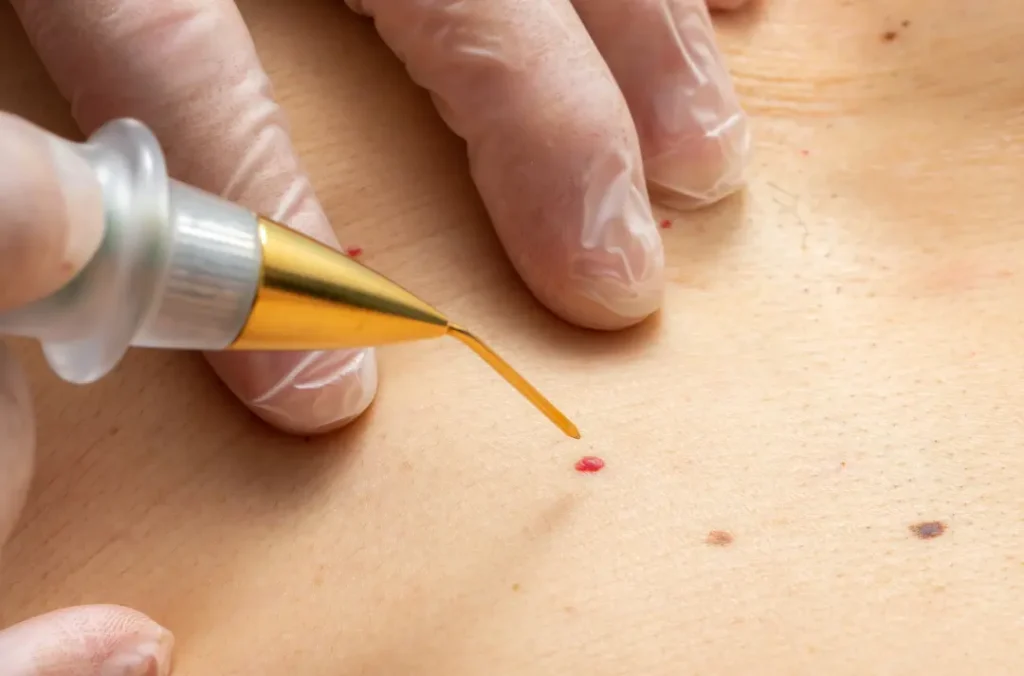
The technique is cauterisation — electrocautery. A fine tip is brought up to temperature by an electrical current and applied directly to the wart tissue, which is broken down by the heat.
The current never passes through you. It heats the instrument, and the instrument does the work, which is a distinction worth making because people picture a shock and that is not what this is. The tip is small, so the heat goes where it is put and very little else is affected.
The real advantage is that the practitioner can see it happening. Tissue changes visibly as it is treated, so the decision to stop is made by eye, in the moment, on that particular wart. Nothing is set in advance and nothing carries on working after you have left the room. Compare that with a preparation you apply at home, which keeps going between applications whether or not it is doing what you wanted, or with freezing, where the cold spreads outwards from the point of contact and takes a rim of healthy skin with it.
It also means several can be dealt with in the same visit. Each one is assessed and treated individually rather than being grouped together, which matters because they are rarely all the same thickness or the same age.
The first step is someone looking at it properly, and that part costs nothing.
The appointment
What happens on the day
Five stages, in this order, every time. None of it is improvised and none of it should come as a surprise on the day.
The area is cleansed
Everything starts from a clean surface. Makeup, moisturiser, sunscreen and the ordinary film of the day all come off first, because anything sitting on the skin sits between the numbing cream and the skin it is meant to reach.
Numbing cream, then a cover
Numbing cream is applied to each wart individually and then covered with a plastic film. The cover is not there to hold the cream on. It traps warmth and moisture against the skin, and that is what carries the cream in properly rather than leaving it sitting on the surface.
Cream off, alcohol on
The cream is removed and the area is sanitised with alcohol. Two jobs at once: the residue has to be gone before any heat is applied, and the surface has to be genuinely clean at the moment the skin is about to be opened.
Cauterising, one by one
The tip is applied to each wart in turn. Individually, deliberately, with the practitioner watching the tissue and stopping when that particular one has had what it needs. This is the part the numbing was for.
Healing ointment
A healing ointment goes on before you leave, and you go home with instructions to keep applying it. The sites are small open wounds now, and how they are kept over the next few days has more to do with the final appearance than the treatment itself does.
Any of those five steps worth asking about before you commit to it?
Choosing between them
Cauterising, against the two things most people try first
Almost everyone who books this has already been to a pharmacy. That is not a mistake and we are not going to pretend it is — but the three routes behave so differently that it is worth setting them side by side.
Cauterisation in clinic
- Heat applied directly to the wart tissue by a fine tip
- Numbed beforehand, so the treatment itself is tolerable
- The endpoint is judged by eye, wart by wart, as it happens
- Done in a single appointment; nothing continues afterwards
- Leaves a defined site that scabs and heals, with aftercare that matters
Salicylic acid at home
- Softens and dissolves the thickened layer gradually, application by application
- No numbing needed, but it has to be kept up for weeks without gaps
- No way to see how deep it has got; you are working blind
- Keeps acting on whatever it touches, including the skin around it
- Cheap and private, and it genuinely does work for some people
Freezing
- Destroys tissue with extreme cold instead of heat
- Usually done without numbing, and it is sharply uncomfortable
- The cold spreads outwards, so the margin is less controlled
- Often needs repeating at intervals before anything shifts
- Commonly blisters, which is expected but unpleasant on a hand
There is no universally right answer here, only the right one for what you are actually looking at. Something small and new may well come off with patience and a pharmacy bottle. Something thick, long-standing, in an awkward spot, or one of several, is where a single controlled appointment starts to make more sense than another month of trying.
Tried the bottle already and got nowhere? That is the usual starting point.
Getting ready
Before, and the days after
The aftercare is short, and it is not optional. Two instructions carry nearly all of the outcome, and both of them are about leaving the site alone.
Coming in
- Arrive with the area as it normally is — clean and plain. It will be cleansed here in any case, so nothing needs preparing at home.
- Stop working at it. Filing, cutting, picking and squeezing in the days beforehand leave the surface sore and broken, which makes for a worse starting point, not a better one.
- Mention anything relevant at the consultation — what you have already tried, how long it has been there, and anything about your health or medication that a practitioner should know before any heat is used.
- Reschedule rather than arrive with broken, weeping or infected skin over the area. It is far easier to move an appointment than to treat a site that is already inflamed.
Afterwards
- The first day: do not wash the area for 24 hours. Not a rinse, not a quick shower over it. This is the single instruction people get wrong and it matters more than any of the others.
- Keep the ointment going. Reapply the healing ointment or cream as you were shown, and keep doing it — a site that is kept covered and moist closes over better than one left to dry out and crack.
- Let the scab do its job. It will lift on its own when the skin underneath is ready. Picking it off early is the most reliable way to turn a clean result into a mark that lasts.
- Once it has healed: the new skin is fresh and takes sun badly, so keep it covered or protected for a while. Easy enough for most of the Ottawa year, and worth remembering in July.
How many sessions
We will not give you a number before we have seen it
The number of appointments varies with the case, and any page that promises you a figure without looking at your skin is guessing.
What it depends on is straightforward enough: how many there are, how thick and how established each one is, where it sits, and how your skin responds to the first treatment. A single small one and a cluster that has been spreading for a year are not the same job, and pretending otherwise would only set you up to be disappointed.
There is also the honest point about recurrence. Cauterising removes the tissue that has been built. It does not vaccinate you. The virus that caused it can still be present in skin that looks completely normal around the site, which is why some people are finished after one appointment and others see something reappear nearby later on. That is the nature of what is being treated, not a sign that anything went wrong, and it is a great deal better to hear it now than afterwards.
What we can tell you, once we have actually looked, is whether this is the right route for what you have — and if it is not, we will say so.
Bring it in and we will tell you what we are looking at. No charge for that conversation.
Why here
Four practical things about having it done in Ottawa
Less about the method and more about how the appointment fits into a week.
The assessment is free, and it is the part that decides everything
You are not committing to a treatment by coming in to be looked at. A great deal of what determines the result is settled before anything is switched on, and we would rather have that conversation with the skin in front of us than over a message.
Plan the day around the water, not the appointment
The visit is the easy part. The 24 hours afterwards are when you need the site left dry, so it is worth a moment’s thought about swimming, the gym and when you would normally shower before you pick a slot.
Our colder months are a kinder time to heal
For much of the Ottawa year a healing site on a hand or an arm spends its week under a sleeve, out of the sun and out of the way without you having to think about it. In high summer it takes rather more deliberate covering.
More than one is normal
People often hold off because they have several and assume it means a course of visits. Each is treated separately in the same appointment, so bring all of them to the consultation rather than the one that bothers you most.
Also on McCarthy Road
Other treatments at our Ottawa clinic
- Microdermabrasion in Ottawa — for thickened, rough surface texture across a whole area
- Dermaplaning in Ottawa — blade exfoliation, and the gentlest thing on the menu
- Hydro Facial in Ottawa — deep cleansing and hydration in one sitting
- Microneedling in Ottawa — a different job entirely: remodelling skin rather than removing something from it
- Red Light Therapy in Ottawa — gentle, no downtime, and easy to add to something else
- Our Ottawa clinic — hours, team and everything we offer in Ottawa South