About the treatment
What is actually on the blade afterwards
It is a fair question and the answer demystifies the whole treatment. Two things come off your face, both of them things you were going to lose anyway, and nothing at all goes into it.
The first is dead skin. The outermost layer of your face is a stack of cells that finished being alive some time ago and are queued up to flake away. In a dry climate that queue moves slowly, so the stack thickens, stops reflecting light cleanly and starts catching on everything you put on top of it.
The second is vellus hair — the soft, pale, almost invisible down that covers nearly every face. It is not the same hair as the coarse, pigmented sort on a chin or an upper lip, and it behaves completely differently. It does not respond to laser, because there is no pigment in it to absorb the light, and it does not come back altered by being cut.
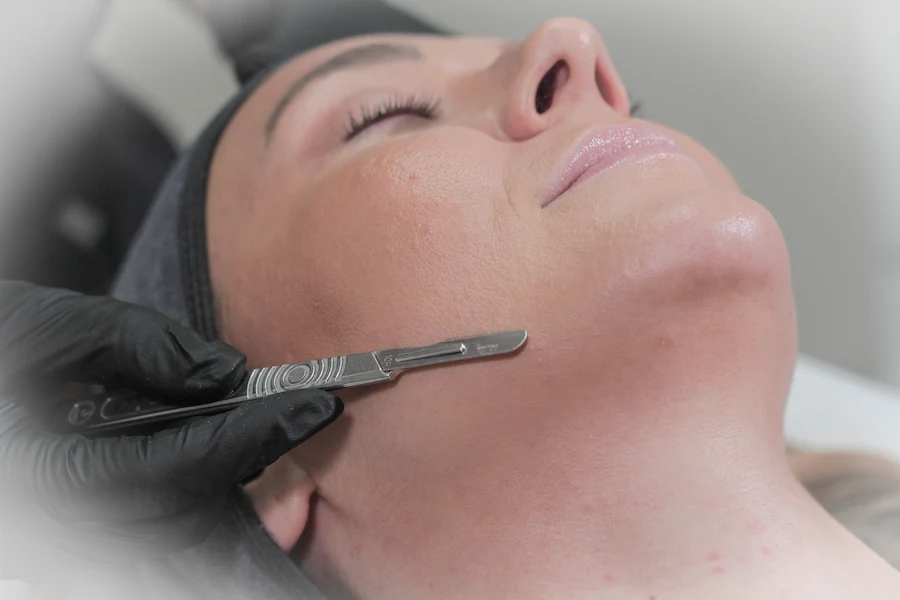
A sterile surgical blade is held at a shallow angle against skin held taut, and drawn across in short controlled strokes. It does not cut into the skin; it skims along the top of it, shearing both of those layers off at once. There is no acid, no heat, no light and no suction. Nothing penetrates and nothing carries on working after you stand up, which is why you can have this done and go straight to a meeting.
Safety
A blade sounds like the harshest option. It is the gentlest.
People rank treatments by how alarming they sound, which puts a scalpel at the top of the list. Ranked by what is actually being done to your skin, it belongs at the bottom.
Waxing and threading pull hair out by the root, which tears a follicle and leaves the area genuinely inflamed for a day. Chemical peels start a reaction that keeps running after you leave and behaves slightly differently on every skin. Abrasive treatments grind at the surface with grit. Light and laser treatments deposit energy into the skin and have to be limited or declined depending on your natural tone.
Dermaplaning does none of those things. It removes material that is already dead and hair that is not attached to anything that matters, in a single plane, at a depth that is fixed by the geometry of the blade rather than by a setting or a chemical. Nothing is absorbed, nothing is systemic and nothing is left behind.
That is why it is often the answer for people whom other treatments rule out — during pregnancy or while nursing, on medication that makes skin light-sensitive, or simply on a face that has reacted badly to every acid it has met. The one thing it genuinely depends on is the person holding the blade, which is why we do not recommend the home versions of this at all.
Why here
Four things about doing this in Ottawa
Less about the science of it and more about how it fits a capital-city winter and a capital-city week.
Wind decides the timing, not the temperature
Ottawa is the coldest of the G7 capitals and the wind crossing the river and the bridges is what actually does the damage. A face that is already chapped and raw should not be bladed that week — we will reschedule rather than work on a compromised surface, and we would rather say that at booking than at the door.
Zero downtime, in a city that meets in person
Between the public service, the embassies and the Hill, a great many people here have a week full of rooms they have to walk into. This is the one treatment on our menu with nothing at all to recover from. You are slightly warm for a few minutes and then you simply look better.
Gatineau in winter counts as sun exposure
Freshly resurfaced skin has no accumulated defence, and a day on the hills in the Gatineau puts real ultraviolet on it from above and off the snow. Sunscreen is not a summer instruction here; it is the week-after instruction in every month.
It is easy to add to something else
We are on McCarthy Road in Ottawa South with parking at the door, and this is the treatment people most often stack onto another appointment. Clearing the dead layer first means whatever follows it is working on skin rather than on debris.
Indications
What is it good for?
The surface, and specifically the two things sitting on it. It is a shallow treatment and it is honest about that.
It will not touch pigment, redness, scarring or anything below the surface. Coarse dark hair is a job for laser rather than a blade. Active breakouts, a cold sore, rosacea in flare or very reactive skin are all reasons to speak to us before booking rather than after. Everything else we run is on the Ottawa clinic page.
Choosing between them
Dermaplaning or microdermabrasion
We run both on McCarthy Road and they are the two treatments clients most often weigh against each other. Both are physical, both are shallow, and they answer two different complaints.
Dermaplaning
- Shears the surface flat with a blade, in one consistent plane
- Takes the vellus hair off as well — nothing else we do will
- Stays entirely on top; never enters the pore
- Very gentle on thin, dry or reactive skin
- Best for a makeup finish and a face that catches the light
Microdermabrasion
- Abrades with diamond grit and clears with suction
- Leaves facial hair exactly as it found it
- Works into the pore opening and pulls plugs out
- Depth is adjusted pass by pass, so it can go firmer
- Best for thickened, weathered texture and congestion
Fuzzy and flat points to the blade. Rough, thickened and blocked points to the wand. They are not rivals and a good number of clients here alternate them across the year — just not in the same week, because that is one exfoliation too many for any face.
Getting ready
Pre & post treatment
Short on both sides. The only real requirement is that the surface arrives intact, because a blade needs somewhere smooth to travel.
In the days before
- Five days: retinol and prescription vitamin A come out. They thin the surface and make it catch.
- Three days: no acids, no scrubs, no cleansing brushes, and no waxing or threading on the face.
- A fortnight: leave a gap either side of a peel, a laser appointment or needling.
- Reschedule rather than arrive with a cold sore, a windburned face, fresh sunburn, an eczema flare or active inflamed breakouts in the area.
In the days after
- Immediately: a little warmth and pinkness that passes quickly. Makeup is fine the same day, and it will go on better than usual.
- That evening: keep it plain. Fresh skin absorbs everything, so this is not the night for the strongest bottle on the shelf.
- A day or two: no sauna, no steam room, no very hot shower, and nothing abrasive.
- Every morning from now: sunscreen, through the Ottawa winter as much as the summer. The layer that used to take the first hit is gone.
Results
Dermaplaning before and after
A You Glow Aesthetics client immediately after a single treatment. Look at the edge of the cheek against the light rather than at the skin tone — what has changed is how evenly the surface reflects.
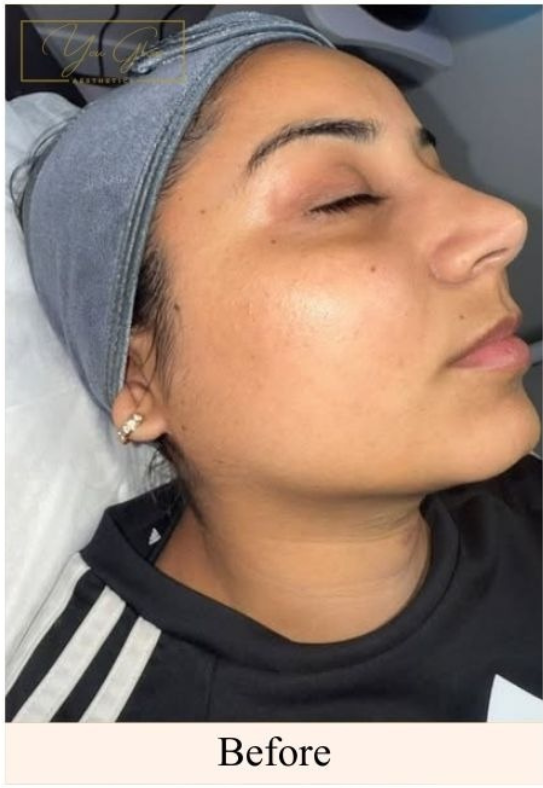
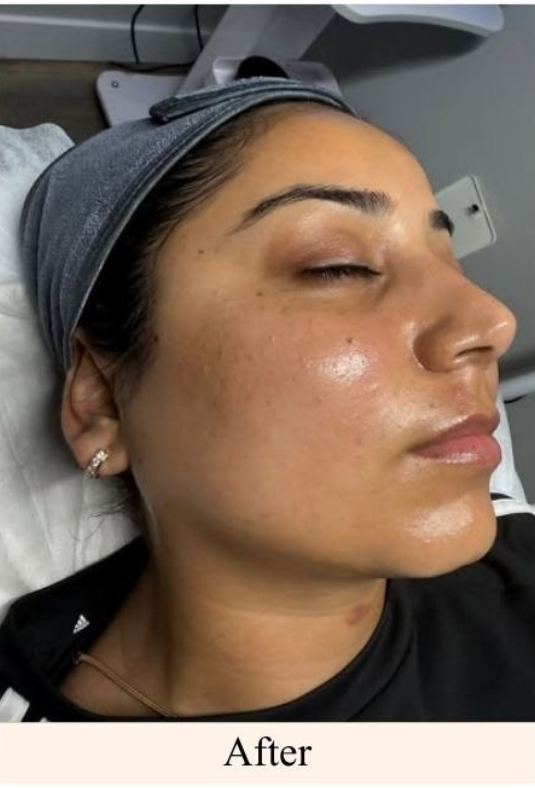
This is a same-day result rather than a course result, and it lasts as long as it takes your own surface layer to rebuild itself. How long that is varies with age and with the season, which is why most people settle into a rhythm rather than a fixed schedule.
Also on McCarthy Road
Treatments that work well around this one
- Microdermabrasion in Ottawa — the firmer option for thickened, congested skin
- Hydro Facial in Ottawa — cleansing and hydration, and a natural pairing
- AFA Chemical Peel in Ottawa — the chemical route, for tone rather than texture
- Microneedling in Ottawa — for scarring and lines, which sit far deeper than this
- Dermaplaning across You Glow Aesthetics — how we run it at every branch
- Our Ottawa clinic — hours, team and everything we offer in Ottawa South