About the treatment
Light does three useful things to acne, and one it cannot
Acne is not one problem. It is bacteria, oil, inflammation and scarring arriving in sequence, and a treatment that helps with three of those is still not a treatment for all four. Knowing which is which is how you avoid wasting a year.
Bacteria. The organism involved in inflammatory acne produces porphyrins as a by-product of its own metabolism. Those compounds absorb light in a narrow band, and when they do, they release reactive oxygen inside the bacterium. Pulse light delivers that band, among others, straight into the follicle.
Oil. Some of the energy is absorbed deeper, in and around the sebaceous gland. A gland that is running hot produces less afterwards, and less oil in the follicle means less to block it.
The redness left behind. This is the part people underestimate. Half of what makes a face look acne-covered is not the spots themselves but the flat red marks around where spots used to be. Those are dilated vessels, and pulse light empties them efficiently.
What it cannot do is fill an indented scar. Once the skin has lost tissue, no amount of light brings it back, and we will tell you that at the consultation on Macleod Trail rather than sell you six more sessions.
The honest limit
Two reasons we might say no
Both come up regularly and both matter more than whether your acne is bad enough.
Your skin tone, and any tan on it
Pulse light cannot distinguish the pigment it is meant to target from the pigment evenly present in your skin. The deeper the natural tone, the narrower that margin becomes and the higher the chance of a burn or a pale patch. A tan does the same thing temporarily, and a February ski week counts. We check tone at every appointment and will move a session rather than risk it.
Isotretinoin, now or recently
Skin stays fragile for months after a course finishes. Tell us and we will wait. Working around it is not something any responsible clinic should offer.
Deep cystic acne that is still active
Light will help with the inflammation around it, but cystic acne is a medical problem and it deserves a doctor first. We would rather send you to one and treat the aftermath properly than take your money for a course that disappoints.
Skin that is broken right now
Open, weeping or freshly picked areas are left alone until they close. That is a delay of a week or two, not a refusal.
Why here
What Calgary does to a breakout-prone face
Dry climates are supposed to be good for acne. In practice this one creates its own version of the problem.
Dehydrated skin produces more oil, not less
Calgary air strips water out of the surface, the skin reads that as a problem and compensates with sebum. A great many of the oily, congested faces we see here are actually dehydrated ones overproducing.
Then people over-strip them
Foaming cleansers, astringents, a scrub. It feels right and it accelerates the cycle. Expect us to ask what you are using and to be direct about which of it to stop.
Chinooks swing everything in an afternoon
A twenty-degree temperature change and a collapse in humidity in a few hours. Skin that was balanced in the morning is tight and flushed by three, and inflamed acne flares with it.
Winter is the right season to run a course
Three to five sessions several weeks apart, and every one of them needs untanned skin. From November to March that is easy. Starting in June is not.
Indications
What is it good for?
Active inflammatory breakouts, and just as importantly the marks they leave behind.

Indented scarring needs microneedling, and blocked pores that are not inflamed do better with a hydro facial. Everything we run in south Calgary is on the Calgary SE clinic page.
Choosing between them
IPL or blue light therapy
Both are light and both are offered here for acne, which makes this the question we get asked most. They are not competing; they suit different stages.
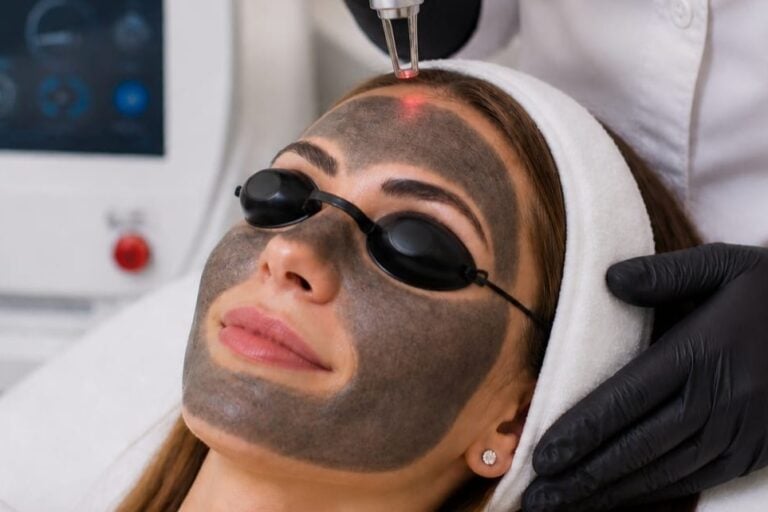
Acne facial with IPL
- A broad band of wavelengths, some of them reaching the gland and the vessel
- Works on bacteria, oil production and the red marks left behind
- A short course of three to five, weeks apart
- Restricted by skin tone, and off the table on a tan
Blue light therapy
- One narrow band, absorbed at the surface of the follicle
- Works on bacteria and inflammation, not on pigment or vessels
- Gentler and repeatable more often
- Safe on every skin tone, including ones IPL is not right for
If your main complaint is the flat red marks rather than the spots, IPL is clearly the better choice. If you are mid-flare and your skin is deeper toned or reactive, blue light is where we would start.
Getting ready
Pre & post treatment
The four-week sun rule is the one that gets sessions cancelled. Everything else is straightforward.
Before each session
- Four clear weeks with no sun, no booth and no self-tan. Fake tan reads as pigment to the machine and it burns.
- Stop retinoids and benzoyl peroxide a week out, acids three days out.
- Do not squeeze anything in the days before. Broken skin cannot be treated.
- Tell us about every acne medication you are on or recently stopped, including the oral ones.
Afterwards
- Warm and pink for a few hours, and spots can look more defined for a day before they settle.
- Sunscreen every morning without exception, winter included.
- No sauna, hot tub or hot yoga for 48 hours.
- Nothing active for five days, then reintroduce one product at a time.
Also on Macleod Trail
Treatments that work well around this one
- Blue Light Therapy in Calgary SE — the gentler light route, safe on every skin tone
- Hydro Facial in Calgary SE — for clearing the pore itself, and for the dehydration underneath
- Microneedling in Calgary SE — for indented scarring, once the acne has settled
- IPL Facial in Calgary SE — the same technology for sun damage and general redness
- Our Calgary SE clinic — everything we run in south Calgary