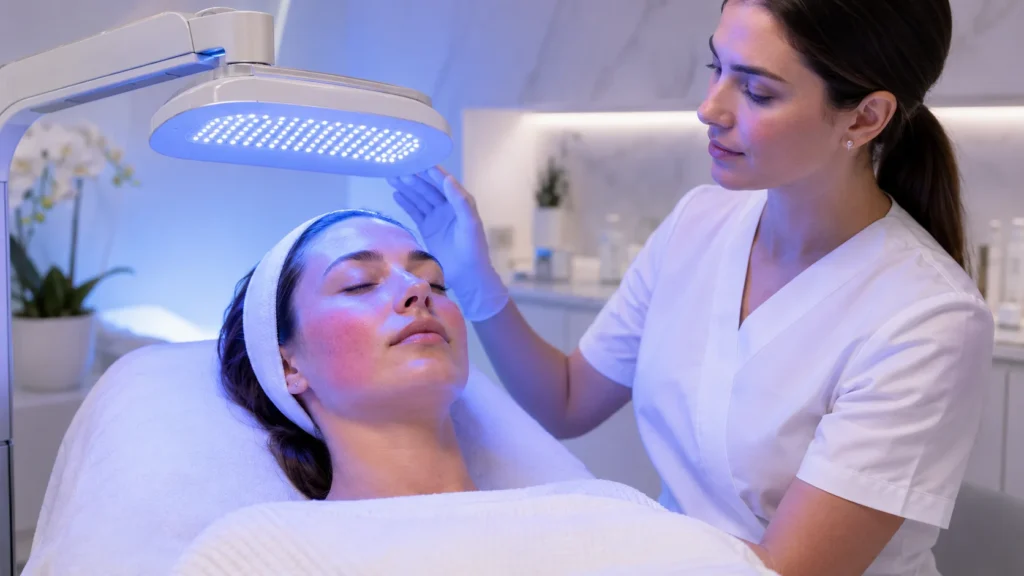
Your skin looked calmer after your first blue light session, and now you are wondering how often you should come back. Weekly? Monthly? Until the breakouts stop?
This guide helps you decide how to plan a blue light series, how to tell whether it is working, and what we cannot promise. Where there is no set number, we will say so rather than invent one.
Key Takeaways
- The usual pattern is a weekly starting series, then monthly maintenance, but your plan is personalized.
- Blue light targets inflamed, bacteria-driven spots, not blackheads, closed bumps, or marks.
- Judge progress by counting active spots, and give your skin time after the last visit before deciding.
- Deep, painful, scarring, or suddenly appearing acne deserves a doctor’s opinion.
The Usual Blue Light Rhythm: A Weekly Series, Then Monthly Upkeep
Our Blue Light Therapy page describes a pattern most clients follow. Think of it as a starting point, not a prescription, since your esthetician shapes the plan around your breakouts and goals.
| Phase | Typical pattern | Worth knowing |
|---|---|---|
| Starting series | 4 to 6 sessions, about a week apart | The best results come from a series, not one visit |
| Maintenance | Monthly after the series | Meant to help keep skin clear |
| Session length | Not a set figure | Confirmed at consultation |
| Total timeline | Not promised | Varies with breakout type, skin and routine |
After the starting series, monthly sessions are meant to help keep skin clear. If your skin stays calm, you and your esthetician can decide together whether to keep that rhythm or adjust it.
We do not quote a standard number of weeks, and we cannot say how long clear skin lasts after treatment. Your plan is built around your own skin.
Why One Blue Light Session Rarely Tells the Whole Story
New spots form while older ones are settling, so a single session can feel promising without changing the overall pattern. A regular rhythm gives the light repeated chances to work on the inflamed spots your skin has right now.
The American Academy of Dermatology makes a similar point in its guide to lasers and lights for acne. Most people need a series of treatments; studies show multiple treatments deliver significantly better results than a single one, and there is no way to know in advance who will see clearer skin.
Is a Weekly Series Right for Your Kind of Breakout?
Blue light is selective, which is why the series makes sense for some breakouts and not others. The American Academy of Dermatology says visible light can treat pimples but is not effective against blackheads, whiteheads, cysts or nodules.
| What you are seeing | Does blue light reach it? | Often a better fit |
|---|---|---|
| Red, raised, sore spots | Yes, the main target | Blue light series |
| Redness around breakouts | Yes, it may ease alongside | Blue light series |
| Blackheads and closed bumps | No, light passes over them | Deep-cleansing facial or HydroFacial |
| Flat marks after healing | No | An AFA peel |
| Scarring or pitting | No | Microneedling, once acne is controlled |
| Deep, painful lumps | A medical question | Your doctor or dermatologist |
If your face is mostly congestion rather than inflamed spots, we will tell you honestly that a different appointment is the better first step.
Want a Schedule Built Around Your Own Breakouts?
The best session plan depends on the kind of acne you have, your routine, and your calendar. You do not have to work it out alone, and asking costs nothing.
Gather a list of what you use and a few recent photos, then bring your photos and product list to a free consultation about your series. We will talk through spacing, expectations, and whether blue light is the right place to start.
Tracking Progress Between Sessions
Count the active spots rather than judging your whole complexion. Evenness of tone changes more slowly and is a different job for a different treatment. A simple log can make the trend easier to see.
| What to track | How | Why it helps |
|---|---|---|
| Active spots | Count red, raised, or sore ones | This is what the light acts on |
| Photos | Same room and light, no makeup, weekly | Shows the trend, not a single bad day |
| Redness | Note how angry skin looks around breakouts | May ease alongside the spots |
| Life changes | New products, stress, travel, hormonal shifts | May explain flares outside the treatment room |
Bring the log to your appointments. It gives your esthetician something concrete to work from.
When to Reassess, Space Out or Change Course
A good time to step back is at the end of your first series. Ask whether the number of inflamed spots is lower, whether redness has eased, and whether you manage flare-ups better at home.
Give your skin a little time before you decide. The American Academy of Dermatology notes that in studies, patients often see their best results weeks after the last treatment, so a quiet week at the end of a series is not a verdict.
If the answer is mostly yes, monthly maintenance may make sense. If progress is slower than hoped, that is useful information too. It may mean adjusting timing, adding another treatment, or looking at triggers outside the clinic, which our post on why acne treatments fail without a personalized plan explores in more depth.
Fitting Blue Light Around Facials, Peels and Daily Triggers
Blue light often works best as one piece of a bigger plan. It is commonly paired with deep-cleansing facials or extractions, and at our Calgary SE clinic, active inflamed breakouts are usually paired with blue light rather than adding more facials. Tell your esthetician about every appointment you have booked so the plan can be sequenced sensibly.
Daily triggers matter too. Blue light treats the spots that are there, but not whatever keeps causing them, and heat and friction from helmets or masks worn for hours can keep jawline breakouts going. If you are weighing it against a peel, our comparison of blue light therapy vs chemical peels for active acne breaks down the differences.
Blue light is a cosmetic treatment, not a medical one. See a doctor or dermatologist if you have deep, painful lumps that last for weeks and leave marks, acne that appears suddenly in adulthood alongside other changes, or acne that is already scarring. The same goes if you are pregnant or have a medical condition and are unsure whether light treatments suit you. We are glad to work alongside a doctor, but we are not a substitute.
Getting Ready for Each Session, and Recovering Well
Consistency is easier when you arrive prepared. Small timing differences exist between clinics, so follow the guidance your clinic gives you.
- Arrive clean. Foundation, SPF, or heavy cream on the surface can get in the way of the light.
- Pause actives briefly. Skip harsh exfoliants, retinoids, and acids for 2 to 3 days before; some clinics also ask you to skip waxing, threading, and vigorous scrubs for 48 hours.
- Check medications. Some acne medications and antibiotics carry a photosensitivity note, so tell your esthetician what you take and apply.
- Do not postpone for breakouts. Active breakouts are what this treatment is designed for.
- Afterwards, expect possible mild warmth or redness, pause actives for 2 to 3 days, skip saunas and heavy workouts for 24 hours, and wear sunscreen daily.
Protective goggles are provided during sessions, and LED therapy, unlike UV light from the sun, does not cause tanning or skin damage.
Where to Book Blue Light Therapy
Dedicated blue light pages exist for Red Deer, Calgary SE, Toronto, Ottawa, and Winnipeg. For Vancouver and Calgary NW, availability can vary by clinic, so please confirm when you book.
Results vary with the kind of acne you have, the length of your series, your routine at home and whether hormones are involved.
Frequently Asked Questions
Can I have blue light therapy more often than weekly?
The usual starting pattern is about one week apart, and there is no published rule for adding visits. Ask your esthetician before booking extra sessions, since the right spacing depends on your skin and the kind of breakouts you have. Your plan can be adjusted if your skin or calendar changes.
When should I judge whether the series worked?
Not straight after the last visit. The American Academy of Dermatology notes that in studies, patients often see the best results weeks after the last treatment. Compare your photos and active spot count at the end of the series and again a few weeks later, then review the plan with your esthetician.
How soon will I notice a difference?
You may notice a calmer complexion after one visit, but the best results come from a series. There is no promised timeline, since results depend on your skin and settings. Count active inflamed spots over several weeks rather than judging after a single session.
Is blue light therapy safe for my eyes?
Protective goggles are provided during the session so your eyes are shielded from the bright light. Unlike UV light from the sun, LED therapy does not cause tanning or skin damage. Tell your esthetician about any medications with a photosensitivity note before your first visit.
Should I keep using my acne products during a series?
Tell your esthetician what you use before your first session. Retinoids and acids may need pausing for 2 to 3 days around treatment, and a photo of your products helps. If a doctor prescribed something, follow their advice, and ask them if you are unsure.
Plan Your Blue Light Series With Us
The right schedule is the one built around your skin, your breakouts, and your calendar. You do not need to commit to anything to ask about it.
If you would like a rhythm that makes sense for you, ask us how to space your blue light series and bring your photo log. We will look at your skin and tell you honestly if another treatment, or a doctor, is the better first step.