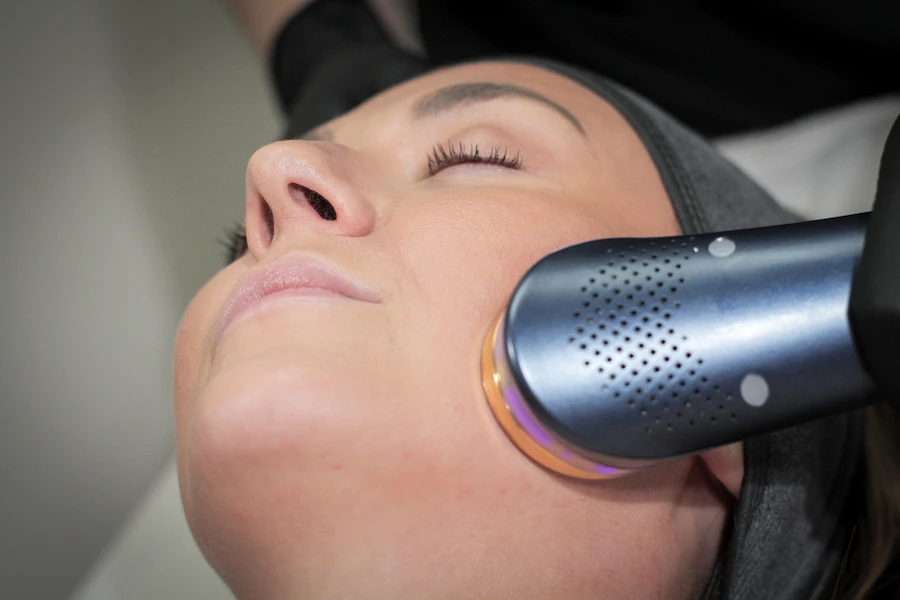
About the treatment
Why blue light kills the bacteria and not your skin
Inflammatory acne is a bacterial problem with an immune reaction on top. A pore blocks, the airless pocket that results is ideal for Cutibacterium acnes, and the swelling and soreness are your own immune system responding to the colony inside.
Those bacteria produce compounds called porphyrins as a by-product of their own metabolism. Porphyrins absorb blue light at a particular wavelength, and when they do they generate reactive oxygen inside the bacterium that destroys it. Human skin cells make no porphyrins, so the same light passes through them without doing anything.
That selectivity is the entire appeal. No acid, no abrasion, no antibiotic, no drying agent. Which is why blue light is very often what is left when someone’s skin has become too dry and too irritated to keep using the creams they were prescribed. At our Pembina Highway clinic it is used on its own and immediately after extractions, to stop a deep-cleansing facial turning into a breakout three days later.
How it works
Three things at once
This is why it does more than a spot treatment: it addresses the bacteria, the fuel and the reaction in the same session.
The bacteria
Killed on the surface and inside the pore, which is where creams struggle to reach and where the colony driving the swelling actually lives. This is the part that stops new spots forming rather than treating the ones already there.
The oil
The light has a calming effect on sebaceous glands, so they produce less of the oil that blocks pores in the first place. Fewer blocked pores means fewer airless pockets for bacteria to colonise.
The reaction
The redness and swelling around a spot are immune response, not infection, and blue light quietens it. This is the effect people notice first — skin looks less angry after one session, well before any clearing has happened.
Being straight with you
Why acne comes back, and what maintenance means
Nobody selling acne treatment enjoys this conversation, so most avoid it. It is the most useful thing on this page.
Acne is a condition, not an injury
An injury heals and is finished. A condition is an ongoing tendency — toward oil production, toward pores blocking, toward inflaming. Treatment lowers the level; it does not remove the tendency. Anyone promising a permanent cure is selling you something.
What a course actually achieves
Four to six sessions about a week apart drops the bacterial population and settles the inflammation substantially. Skin becomes calmer, then clearer. That state is real and worth having — it is just not self-sustaining.
Why monthly maintenance is the model
Bacteria repopulate and oil keeps being produced. A monthly session holds the level down rather than letting it climb back over three months. This is the same logic as a dental cleaning, and about as unglamorous.
What we will not claim
That this replaces a dermatologist for severe cystic acne, or that it will work equally on every type of breakout. Comedonal congestion responds differently from hormonal cystic acne, and we will tell you which one you appear to have.
Indications
What is it good for?
Active, inflammatory acne above all — the red, raised, sore kind rather than the flat marks it leaves behind.
For the flat marks acne leaves, an AFA peel is the tool; for indented scarring it is microneedling. Everything else is on our Winnipeg clinic page.
Why here
Breaking out in a Winnipeg winter
The seasons here cause acne for opposite reasons, and both of them make the standard routine harder to stay on.
The drying trap
Standard acne treatment works by drying. Apply that to skin already stripped by five months of heated indoor air and it becomes intolerable — so people stop, the acne returns, and they conclude nothing works. Light breaks that cycle because it dries nothing.
Dehydrated skin overproduces oil
Strip the barrier and the skin compensates by making more oil, not less. This is why aggressive drying routines so often make winter breakouts worse rather than better, and why the answer is usually to calm the skin rather than attack it harder.
Scarves, toques and friction
Months of wool against the jaw and chin means trapped heat and constant friction exactly where breakouts concentrate. It is a genuinely seasonal pattern here, and it responds well to a course run through the winter.
Humid summers, the other way round
Prairie humidity pushes oil production up and leaves sweat sitting on the skin. July and August are reliably the worst months for congestion — and LED adds no sun sensitivity, so a course can run straight through them.
Getting ready
Pre & post treatment
Short on both sides. The main thing is arriving with genuinely clean skin, because anything on the surface blocks the light before it reaches the pore.
Getting the light to your skin
- A properly bare face. Foundation, tinted moisturiser and mineral SPF all sit between the light and the pore.
- Give the acids a rest for a couple of days beforehand — scrubs, retinoids and exfoliating acids alike.
- Tell us what you are on. Prescription acne medication in particular changes what we do, sometimes substantially.
- Flag open or broken skin, anything freshly done to your face, and any tanning in the past week.
Once you are home
- A flush for an hour or so is all most people get. There is nothing to hide and nothing to plan around.
- Do not let the skin dry out. A mild cleanser and a light moisturiser — dryness is what you are trying to avoid.
- Give it two or three days before any active goes back on.
- Nothing steamy for the first day: saunas, steam rooms, a hard workout.
- Sunscreen in the morning, the same as after anything else.
Results
Blue light therapy before and after
A client treated at You Glow Aesthetics. Note what changes: fewer active, inflamed spots and considerably less redness around them.
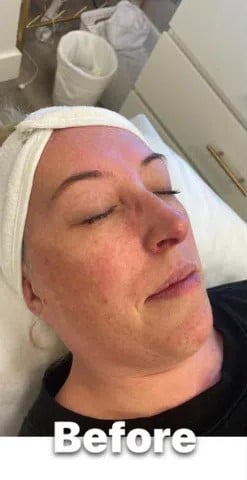
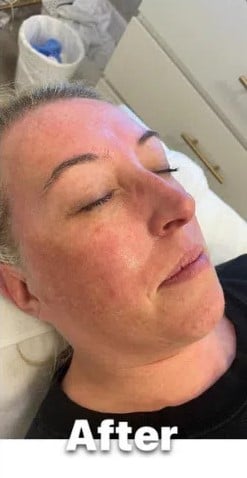
Individual results vary with the type and severity of the acne and how many sessions are completed. Maintenance is what holds a result like this.
Also at our Winnipeg clinic
Treatments that work well around this one
- Hydro Facial in Winnipeg — clears the pores first, so the light has less to work through
- AFA Chemical Peel in Winnipeg — for the discoloured marks left after the spots have gone
- Microneedling in Winnipeg — for indented scarring, once the active acne has settled
- Anti-Aging Red Light Therapy in Winnipeg — the other wavelength, for redness and repair
- Dermaplaning in Winnipeg — between breakouts, for congestion and surface build-up
- Blue light therapy brand-wide — how the treatment works across all our clinics