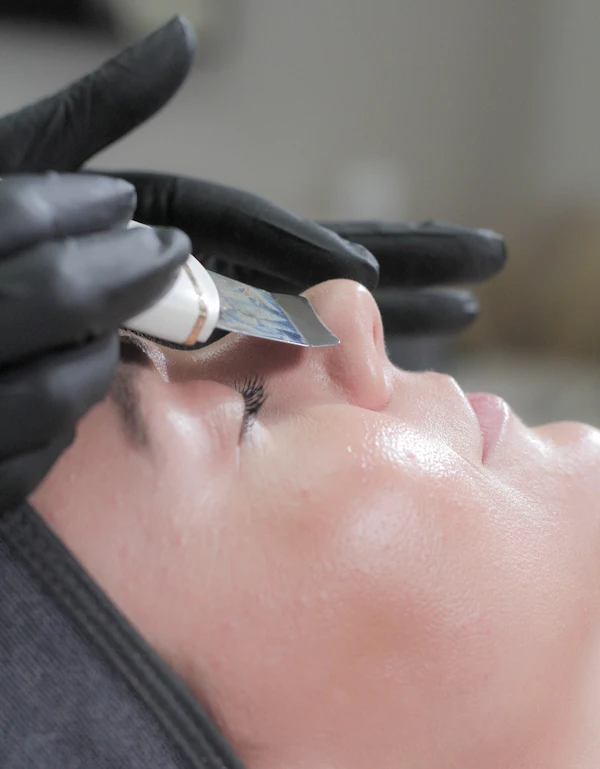
About the treatment
Brightening means two different things, and only one of them lasts
Almost every complaint that arrives under the word “dull” is really one of two problems. They look similar in the mirror and they need completely different treatments, which is why so many people spend money in the wrong direction.
The first is light. Skin with a thick layer of dead cells on it scatters light instead of reflecting it, so it reads as flat and grey no matter how even the tone underneath is. Remove that layer, hydrate what is left, and the face looks lit from within the same afternoon. That change is real and it is also temporary, because the layer rebuilds.
The second is pigment. Melanin sitting in patches — from sun, from a pregnancy, from a spot that healed badly — makes the tone uneven rather than dim. Nothing that works on the surface will shift it, because the pigment is not on the surface. That work takes ingredients that interrupt how melanin is made, given time, and protection so you are not replacing it as fast as you fade it.
A brightening course at our West Broadway clinic does both, but it starts by telling you which one you actually have.
How a session runs
What happens in the chair
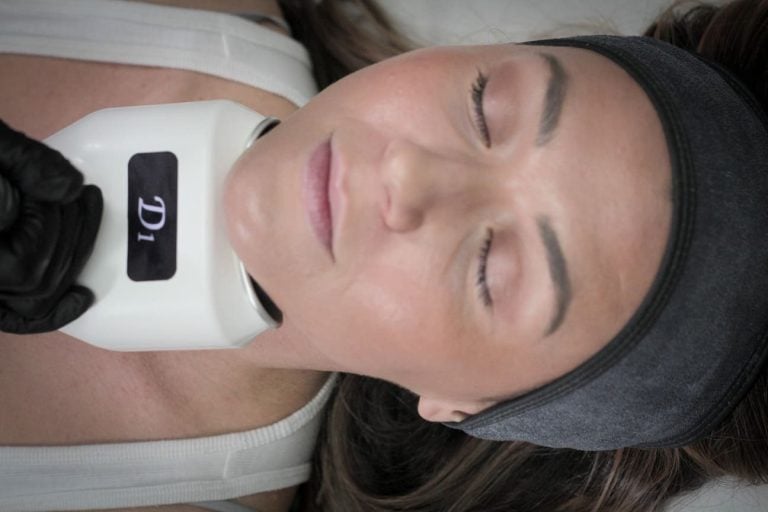
A brightening facial is a sequence, not a product. Each stage exists because the one after it will not work without it.
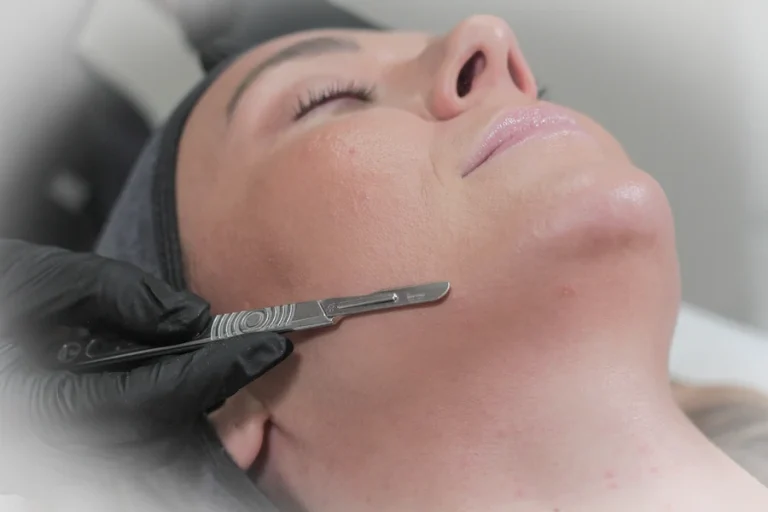
Take the dull layer off
Exfoliation matched to your skin that day. This is the stage that produces the visible change people walk out with, and it is also what lets everything afterwards reach the skin at all.
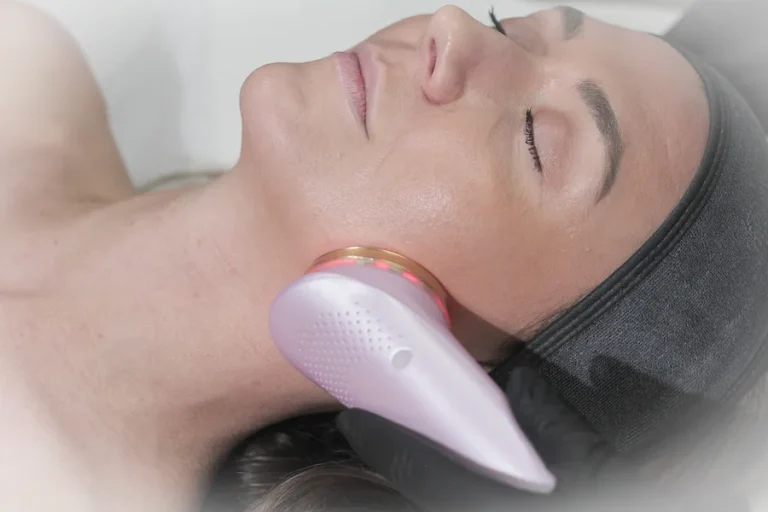
Work on the pigment
Brightening actives — vitamin C among them — applied into freshly prepared skin under a mask. This is the part that compounds. One session does very little; six change the tone.
Protect it
Moisture, barrier support and sun protection. Skipping this stage is not a small shortcut. Unprotected, freshly exfoliated skin pigments faster than before you started.
Why here
Why Vancouver skin looks dull when it is not damaged
This city has a specific version of the problem, and it catches people out because they assume grey weather means low risk.
Flat light tells you nothing
Overcast skies are diffuse, and diffuse light hides unevenness. People notice their pigmentation the week the sun comes out, having had it all winter. That is a lighting change, not a sudden deterioration.
Cloud is not sunscreen
UVA passes through cloud and through window glass, and it is UVA that drives pigmentation. A Vancouver winter is low in the wavelength that burns you and not nearly as low in the one that marks you.
The summer here is intense and short
Beaches, water, mountains, and a population that goes outside the moment it is dry. A great deal of a year’s sun exposure lands in ten weeks, which is exactly when a brightening course needs the most protecting.
Autumn is the right time to start
Beginning in October gives you the whole low-UV stretch to work through a course before the light returns. Starting in June means fading pigment with one hand and making it with the other.
Indications
What is it good for?
Tone rather than texture. Dullness, patchy pigment, sun spots and the marks left behind by old breakouts.
If the surface is rough as well as flat, exfoliation for clear skin is the better starting point. For a defined sun spot with a hard edge, pulse light is more direct. The full Kitsilano list is on the Vancouver clinic page.
Choosing between them
A brightening course or pulse light
Both address tone. One works chemically across the whole face, the other targets individual marks with light. The right answer depends on what your pigment looks like up close.
Facial brightening
- For diffuse, soft-edged unevenness spread across an area
- Safe on every skin tone, including deeper ones
- Gradual — a course over months, with no marks in between
- The safer choice where melasma is suspected
Pulse light (IPL)
- For discrete spots with a clear edge, and for visible vessels
- Restricted by skin tone, and ruled out on tanned skin
- Faster — visible change in a handful of sessions
- Can aggravate melasma, so it is not the default
If you are not sure whether what you have is melasma, do not guess and do not book light treatments on the assumption it is not. That is a conversation to have in person.
Being straight with you
What brightening does not mean
The word carries some baggage, and some of it deserves to be cleared up explicitly.
It is not skin lightening
Nothing here is aimed at making your skin a different colour, and we do not offer anything that is. The goal is your own tone, evenly. Anyone selling you a shade is selling something else.
Pigment is slow and it is patient work
Brightness comes back within a session. Tone takes months, and melasma in particular is managed rather than cured. A clinic promising to clear twenty years of sun in three visits is overselling.
Without sunscreen, none of it holds
This is not an upsell. Daily SPF is the single factor that decides whether a brightening course was worth the money, and in this city people skip it for eight months of the year.
Some marks are not pigment at all
Flat red marks after acne are inflammation, not melanin, and they fade on their own timetable. We will tell you when the honest recommendation is to wait rather than to treat.
Getting ready
Pre & post treatment
Everything on this list exists to stop you undoing the work between appointments.
Before each session
- Pause retinoids for three days and acids for two.
- Arrive untanned. A fresh tan changes what is safe to do and what we can even assess.
- Tell us about hormonal changes — pregnancy, or a change of contraception. Both drive melasma and both change the plan.
- Bring your current products. Half of pigment management happens at home.
Between sessions
- Sunscreen every morning, reapplied on bright days. Not optional on this particular course.
- A hat in July. Vancouver summers do more pigment damage than the whole winter.
- Nothing active for two days after each visit, then back to your routine.
- Photograph it in the same light once a month. Pigment changes too slowly to judge from memory.
Also on West Broadway
Treatments that work well around this one
- Pulse Light (IPL) in Vancouver — for defined sun spots and visible vessels
- Microneedling in Vancouver — where texture sits alongside the tone problem
- Exfoliation for Clear Skin in Vancouver — if congestion is dulling the surface
- Fire & Ice Facial in Vancouver — the fast brightness, for a date in the diary
- Our Vancouver clinic — the full Kitsilano list