About the treatment
Nothing is lightened. Something is removed.
Brightening is a word the cosmetics industry uses for creams that make skin look paler. This is not that, and the distinction matters because it decides what you should expect to see and when.
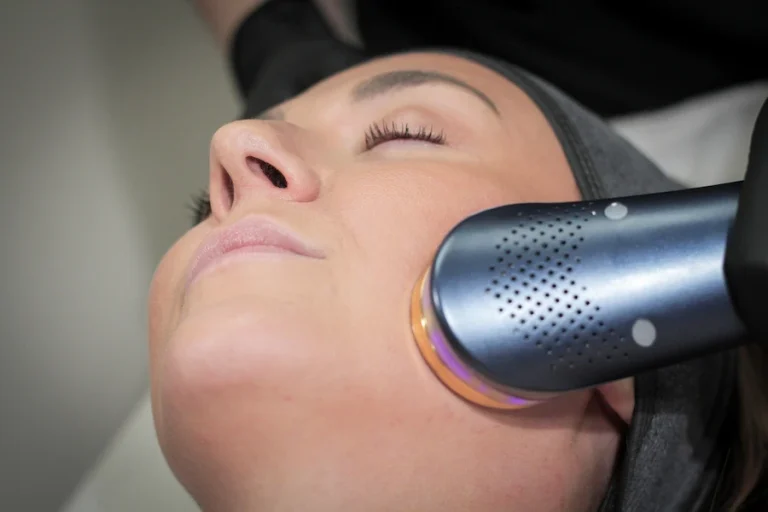
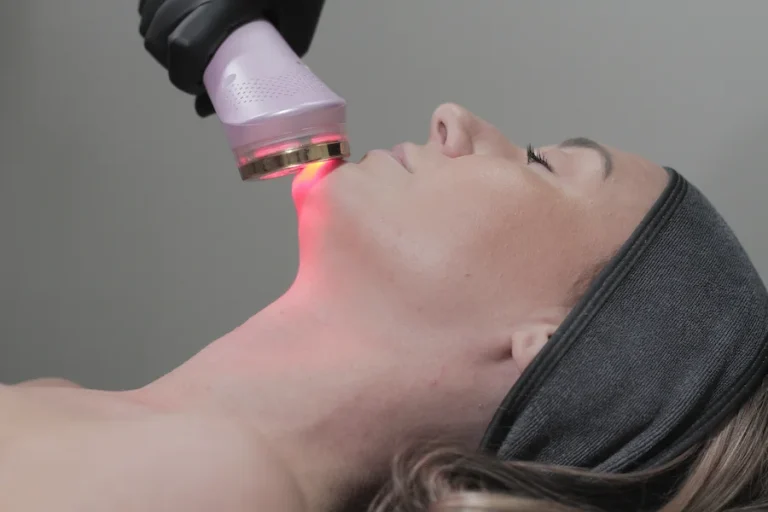
A sun spot is a small, dense colony of pigment-making cells that have been switched on and left on. No cream reaches them. What we do instead is deliver a pulse of light that the colony absorbs far more strongly than the skin around it does. The energy becomes heat, the heat breaks the pigment up into fragments, and the skin then does the rest of the work itself — carrying those fragments upward with its ordinary turnover until they reach the surface and flake off.
So the result is a subtraction, not a coat of paint. The spot does not fade gradually the way a cream would fade it. It darkens first, goes slightly crisp and speckled, and then lifts away over a week or two, leaving the skin that was always underneath it.
People who have not been warned about the darkening find the first few days alarming and some of them stop the course there. That is the single most useful thing on this page: for a fortnight after each session, worse is what better looks like.
Getting the diagnosis right
Three browns that respond, and one that fights back
Brown on a face is not one thing. Two of these are what this treatment was built for, one usually behaves, and the fourth is the reason we insist on looking before we book.
Sun spots and age spots respond well. Flat, hard-edged, darker than the skin around them, in places that see daylight — cheekbones, temples, the backs of the hands, the left forearm if you drive a lot. These are the ideal target.
Marks left behind by old spots and breakouts usually respond. Flat brown stains where a blemish used to be. They would fade eventually on their own; light shortens that considerably.
Freckles respond, and you should decide in advance whether you want them to. They will lighten along with everything else. Some people are delighted and some are not, so we ask rather than assume.
Melasma does not belong here. Soft-edged, symmetrical, usually across the cheeks, forehead or upper lip, and often tied to pregnancy, the pill or hormones. It is driven by heat as much as by light, so pulse light can darken it rather than clear it. If what you have looks like this, we will say so and take a different route entirely.
Alongside all of that sits the limit that applies to any pulse light: the machine cannot tell the pigment in a spot from the pigment evenly present in your skin. The deeper your natural tone, the smaller the gap between those two, and below a certain margin the treatment stops being safe. A recent tan closes the same gap temporarily, which in central Alberta is as likely to come from a bright winter as from a summer.
Why here
Central Alberta writes on a face slowly, over decades
Almost nobody gets their sun spots from a holiday. They get them from twenty years of ordinary life outdoors in a place with a lot of sky.
An outdoor life that never looks like sunbathing
Acreage work, the rink parking lot, a boat on Sylvan Lake, a sled in February, coaching from the sidelines. None of it feels like sun exposure at the time, and all of it is. That is exactly the profile that produces flat brown marks in your forties rather than a burn in your twenties.
The driver’s side of the face
Central Alberta is a driving region. The QEII, the run to Calgary or Edmonton, the commute in from Lacombe or Innisfail. Window glass blocks the burning wavelengths and lets the ageing ones straight through, and the result is a left cheek and left temple that are measurably more marked than the right.
Snow keeps the exposure running all winter
People here stop wearing sunscreen in October and do not start again until May, on the assumption that cold means safe. Fresh snow throws a large fraction of the ultraviolet back up under the chin, the nose and the brow. The pigment you make in February counts the same as the pigment you make in July.
Which makes the dark months the right months
A course sits weeks apart and needs skin with no fresh colour on it. December through March is the cleanest window we get, and being open seven days on Timberlands Drive means the spacing can follow your skin rather than our rota.
Indications
What is it good for?
Discrete brown marks, and the general unevenness that a face full of them adds up to.
If the redness is as prominent as the brown, the general IPL facial is the better setting. If there are still active breakouts producing new marks, deal with those first on the acne facial. Everything we run locally is on the Red Deer clinic page.
Choosing between them
Brightening with light, or with a polish
Two very different reasons a face reads uneven, and two completely different answers. Booking the wrong one is the most common way people conclude that “nothing works” on their pigment.
Brightening facial with IPL
- For pigment that is genuinely there, in defined marks
- Reaches down to where the pigment colony actually sits
- Results arrive over a fortnight per session, and last for years with sunscreen
- Limited by skin tone, and postponed by any tan
- Run as a course in the low-light months
Microdermabrasion
- For a face that looks flat and grey with no marks you can point at
- Removes only the dull, dead layer sitting on the surface
- Results are visible the same day and fade over some weeks
- Safe on every skin tone and in every season
- Repeated on a rhythm rather than worked through as a course
The test takes ten seconds. Stand at a window and look for edges. If you can point at individual marks, that is pigment and it needs light. If the skin is evenly lacklustre and you cannot point at anything, that is surface build-up and a polish will do more for it than any laser. A fair number of Red Deer faces in March have both at once.
Getting ready
Pre & post treatment
Two lists, and one thing that governs both: the skin has to arrive with no colour on it that we did not come to treat.
What has to be true on the day
- No tan of any origin for a month — sun, bed, spray or lotion. Self-tan is the worst of the four, because it colours the exact layer the light passes through first.
- A bare face. No makeup, no tinted sunscreen and no moisturiser applied that morning.
- A settled routine. Retinol paused for a week, acids and scrubs paused for three days, nothing waxed or threaded on the area for a fortnight.
- Us fully briefed on cold sores, on anything you take that makes you burn more easily, and on any brown that appeared during a pregnancy or after starting the pill.
How the fortnight afterwards goes
- Same day: warm, slightly pink, perfectly presentable. Makeup can go back on the following morning.
- Days two to four: the marks go noticeably darker and develop a gritty, speckled surface. Expected. Do not scrub at them and do not try to lift them.
- Days five to fourteen: they shed on their own, usually without you catching the moment. Keep the skin moisturised and let it happen.
- From then on: sunscreen every morning, in every month. It is the only thing standing between this result and doing it all again in two years.
Also on Timberlands Drive
Treatments that work well around this one
- IPL Facial in Red Deer — the general setting, for brown and red together
- Acne Facial (IPL) in Red Deer — when breakouts are still making new marks
- Microdermabrasion in Red Deer — for surface dullness rather than true pigment
- AFA Chemical Peel in Red Deer — a gentler route to a more even tone
- Hydro Facial in Red Deer — cleansing and hydration between light sessions
- Our Red Deer clinic — the full menu on Timberlands Drive