About the treatment
The treatment for the thing you can feel
Most skin complaints are things you see. This one is for the complaint you notice with your fingertips: a cheek that feels like fine sandpaper, foundation that will not sit flat, a serum that seems to stay on top of the skin instead of going into it.
All three of those have the same cause. The outermost layer of your skin is made of cells that are already dead and on their way off. They are meant to shed continuously and invisibly. When that shedding slows down — and in central Alberta it slows down every winter — the layer thickens, dulls, catches the light badly and forms a barrier that your skincare has to fight through.
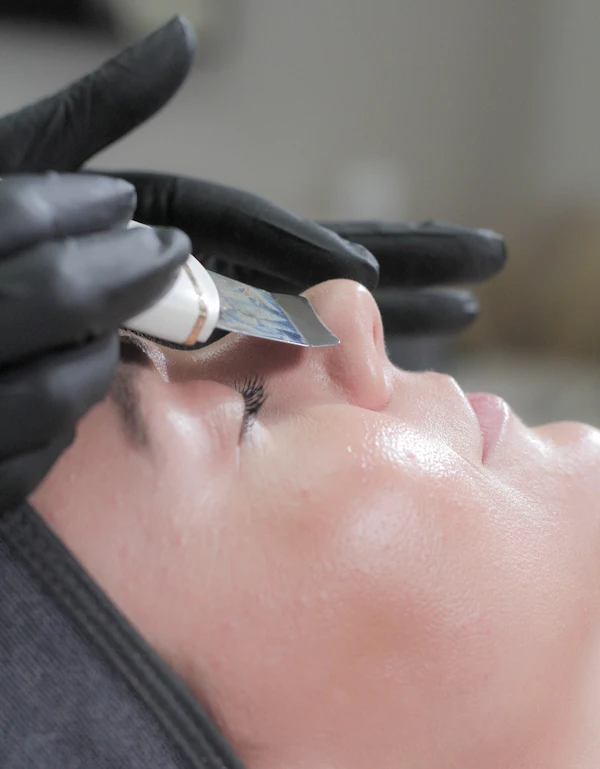
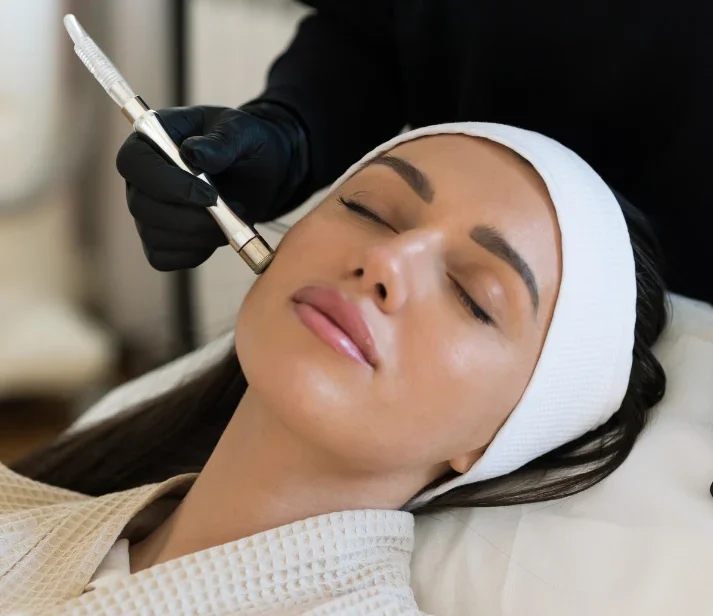
Microdermabrasion takes that layer off mechanically. A wand tipped with industrial diamond grit passes across the face and buffs the dead cells away by abrasion, while suction running through the same handpiece lifts the loosened debris off the skin as it goes rather than pushing it around. Nothing is dissolved, nothing is injected and nothing is heated. It is the most literal treatment we offer: material is physically removed and the newer skin underneath is what you walk out with.
Because the work stops at a layer that was already dead, there is no wound to heal. You are pink for an hour or two and that is the whole recovery. It is the reason this is one of the very few treatments we are happy to run on a Saturday for someone with a Sunday to get through.
The winter problem
Why your skincare quietly stops working in February
People come in convinced their products have gone off, or that their skin has changed. Usually neither is true. The products are fine. They are just not reaching anything.
A Red Deer January runs a long way below freezing outdoors and a long way below comfortable humidity indoors, because heated air holds almost no moisture. Skin responds to both by slowing its turnover and holding onto the dead layer for longer than it should. By the time the light comes back in March, you are wearing several weeks of cells that should have left in January.
That layer does three things at once. It scatters light, so the face reads flat and grey in photographs even when nothing is actually wrong with it. It sits between your moisturiser and the living skin, so the moisturiser does less than it says on the jar. And it gives makeup a rough, uneven bed to sit on, which is why powder starts looking powdery.
Clearing it does not fix the weather. What it does is reset the starting point, so the products you already own go to work on skin rather than on debris — which is generally a cheaper answer than replacing the products.
Why here
What central Alberta does to the surface of your skin
Four local facts, all of which land on the same layer.
The air is dry in both directions
Outdoors, cold air simply cannot carry much water. Indoors, heating that same air pushes the relative humidity down further still. There is no season here where the skin surface is comfortably hydrated by default, which is why build-up is a year-round feature and not just a January one.
Chinook swings are a shock to the barrier
A twenty-degree change over a day and a half is normal here in winter. Skin that has adapted to hard cold is suddenly in mild wind, and the flaking that follows is the barrier catching up. Buffing off the loose layer is a faster route through it than exfoliating acids, which tend to sting on a barrier that is already unhappy.
Outdoor trades, dust and helmets
A great many people here work outside or in a shop, under a hard hat or a balaclava for half the year. That combination — friction, dust and an occluded forehead — congests the surface in a very specific pattern, and it responds well to something that physically clears the pore opening.
We are open seven days on Timberlands Drive
The longest week of any of our branches, which matters for a treatment that people use on a rhythm rather than once. It also means someone driving in from Sylvan Lake, Lacombe, Blackfalds or Innisfail can pick a day that suits the drive rather than the clinic.
Indications
What is it good for?
Surface complaints. The test is simple: if you can feel it with a fingertip, this is probably the right tool, and if you can only see it, it probably is not.
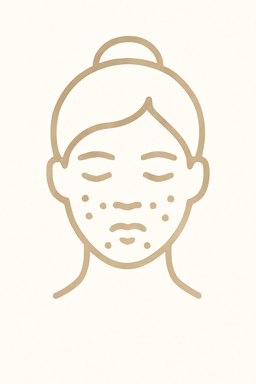
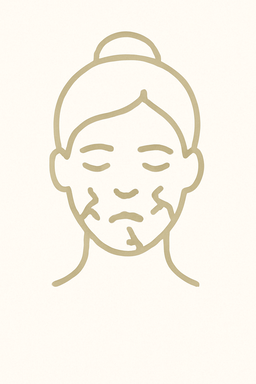
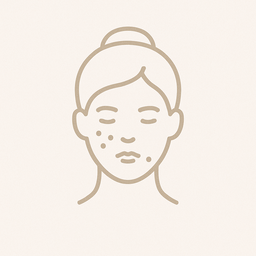
Brown marks and redness are colour rather than texture, and they belong with light-based treatment. Deeper lines and indented scarring need something that reaches past the surface, which is microneedling. Dehydration on its own is better answered by a hydro facial. Everything we run locally is listed on the Red Deer clinic page.
Choosing between them
Microdermabrasion or dermaplaning
Both are physical exfoliation, both are done with a handheld tool, both leave you smoother on the day. They are not interchangeable, and the difference is easier to feel than to describe.
Microdermabrasion
- Abrades with grit and clears with suction
- Works into the pore opening, not only across the top of it
- Better where the complaint includes congestion or blackheads
- Leaves no change to facial hair
- Depth can be dialled up or down pass by pass
Dermaplaning
- Shaves the surface flat with a sterile blade
- Stays on the plane of the skin and does not enter the pore
- Better where the complaint is fine hair and a makeup finish
- Removes the vellus hair along with the dead layer
- One consistent depth, very gentle on reactive skin
Rough and congested points to the wand. Fuzzy and flawless-under-foundation points to the blade. Plenty of people alternate them across the year, and if you genuinely cannot tell which camp you are in, that is a two-minute answer at a free consultation rather than a guess.
Getting ready
Pre & post treatment
Very little is asked of you on either side. The one rule that matters is that you cannot stack two forms of exfoliation in the same week.
In the days beforehand
- Five days: stop retinol and any prescription vitamin A. The surface has to be intact for the wand to work evenly on it.
- Three days: no acid toners, no scrubs, no exfoliating pads, and nothing waxed on the face.
- Two weeks: leave a gap after any other resurfacing treatment, in either direction.
- Tell us at booking if you get cold sores, if you are taking anything that thins the skin, or if you have had a recent burn or windburn.
In the days afterwards
- Straight away: mild pink, a little tightness, and skin that suddenly absorbs everything. Apply the plainest moisturiser you own and be generous with it.
- The rest of that day: nothing hot. That includes a sauna, a hot tub and a very hot shower, all of which will make the flush last longer than it needs to.
- Three days: actives stay out, then go back one product at a time rather than all at once.
- Every day, including the grey ones: sunscreen. Fresh skin has no accumulated defence, and Alberta snow reflects a surprising amount of light back up at your face.
Also on Timberlands Drive
Treatments that work well around this one
- Dermaplaning Facial in Red Deer — the blade route, and the one that takes the fine hair with it
- Hydro Facial in Red Deer — cleansing and hydration rather than abrasion
- AFA Chemical Peel in Red Deer — the chemical way to reach the same layer
- Microneedling in Red Deer — for lines and scarring, which sit deeper than this
- Microdermabrasion across You Glow Aesthetics — how we run it at every branch
- Our Red Deer clinic — everything we offer on Timberlands Drive