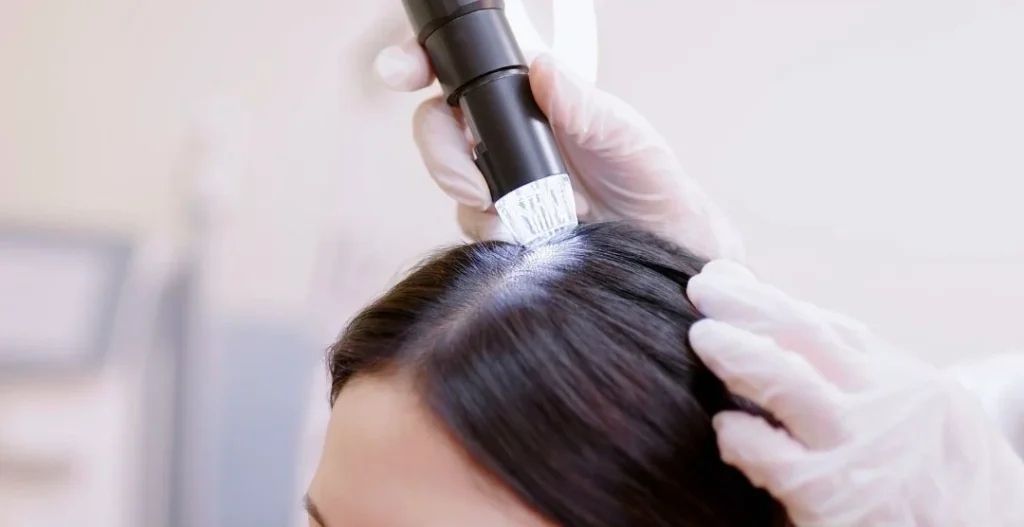
About the treatment
The same principle as facial needling, aimed at the follicle
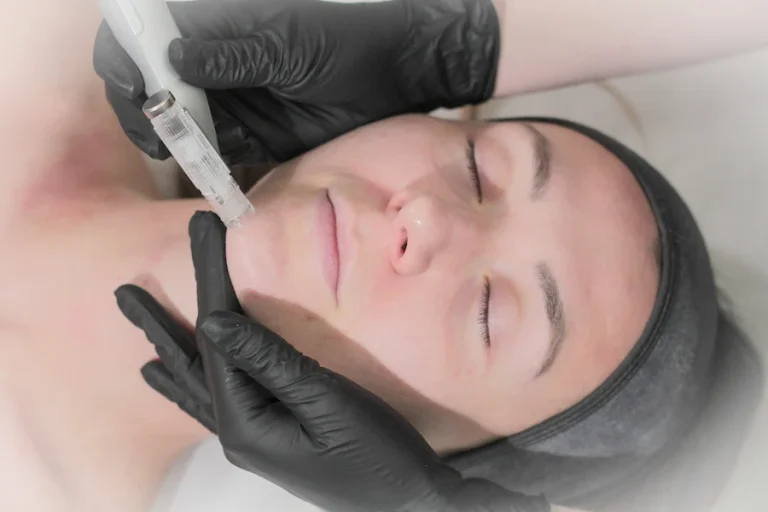
A pen holding fine sterile needles is worked across the scalp, opening thousands of temporary micro-channels in the skin. Your body treats each one as an injury to be repaired, and repair here means blood flow, growth factors and cell signalling arriving in the tissue immediately surrounding the hair follicles.
A follicle that has been producing progressively thinner hair is usually not dead. It is under-supplied and under-stimulated, and the wound-healing response is a way of changing both conditions without surgery and without a prescription.
The second effect is delivery. Any topical applied to an intact scalp mostly sits on it; applied through open channels, far more of it reaches the depth where it can do something. That is why this treatment is so often combined with a product rather than used alone. Numbing cream goes on first at our Macleod Trail clinic, because the scalp is more sensitive than the face.
How it works
Three things the channels set off
None of them are visible on the day. All of them are the reason this is judged in months rather than weeks.
Circulation increases locally
Blood flow through the treated area rises and stays elevated while healing runs. A follicle is metabolically demanding, and more oxygen and nutrients arriving is the most basic requirement for producing a thicker shaft.
Growth factors are released
Wound repair recruits the signalling molecules involved in tissue building, and some of them act directly on the structures around the follicle. This is the mechanism the research on needling for hair actually rests on.
Absorption improves sharply
For anyone already using a topical, this is often the largest practical gain. The same product applied through micro-channels reaches a depth it otherwise never would, which is why the two are usually run together.
Been using a topical for months with nothing to show for it?
Candidacy
Where it helps, and where it cannot
This is the part most clinics are vague about. It is also the part that decides whether you should spend anything at all.
Thinning, not bald
Where hair is still growing but finer, shorter and lighter than it used to be, there is a live follicle to work with. Where the scalp is smooth and has been for years, the follicle has closed and no amount of stimulation reopens it.
Early beats late, considerably
Every month of continued miniaturisation is a follicle further along a path. People who come at the first widening of a parting get more from this than people who wait until it is obvious in every photograph.
It supports; it does not override
If the cause is hormonal, nutritional, thyroid-related or a medication you are taking, needling works against that current rather than removing it. Worth investigating the cause in parallel — and worth saying that we are not the people to diagnose it.
Shedding after an event is different
Hair loss that follows childbirth, illness, surgery or a period of severe stress usually recovers on its own. Needling can support that recovery; it is not the reason it happens, and anyone charging you as though it were is not being straight.
Indications
What is it good for?
Four situations where we would tell you this is worth doing.
A parting that keeps widening
Usually the first thing anyone notices, and usually the earliest point at which the treatment is worth starting. Density here often responds better than anywhere else on the scalp.
Thinning at the crown
The area you cannot see and other people can. Photographs from above at the start of a course are worth taking, because progress here is impossible to judge in a bathroom mirror.
Hair that has gone fine and flat
Not fewer hairs, but weaker ones — the shaft is thinner and the whole head reads as thinner with it. This is miniaturisation, and it is exactly what the treatment is aimed at.
Getting more from what you already use
If you are committed to a topical, this multiplies how much of it reaches the follicle. For many clients that is the strongest single reason to book.
Not sure whether it is early enough to be worth it?
The timeline
The appointment, and then the wait
Hair grows about a centimetre a month. Nothing about the schedule for this treatment can be faster than that.
On the day
Numbing cream for around half an hour, then the pen worked systematically over the thinning areas. Pressure and vibration, with the odd sharper spot near the hairline. The scalp is pink and tender for a day.
Six to eight sessions
Four to six weeks apart, so the course itself runs the better part of a year. Consistency matters more here than in almost anything else we do — a course abandoned at session three tells you nothing.
Judge at three to four months
New growth has to emerge and then become long enough to see. Photograph the same areas in the same light at the start; that comparison is the only reliable way to know whether it is working.
Willing to commit to a year if it is going to work?
Getting ready
Pre & post treatment
Clean scalp going in, and nothing harsh going on it for a few days afterwards.
Before the appointment
- Wash your hair that morning and come with nothing in it — no oil, no dry shampoo, no styling product.
- Pause your topical for 24 hours, including minoxidil. We will tell you when to restart.
- Nothing that thins the blood for a day or two where possible, to limit pinpoint bleeding.
- Tell us about any scalp condition — psoriasis, eczema, an infection. It may mean postponing.
- Allow extra time for the numbing cream to work.
The days after
- Pink, warm and slightly tender for about 24 hours. Some pinpoint marks are normal.
- No washing for a day, then a mild shampoo and gentle hands.
- No colouring, bleaching or chemical treatments for a week.
- No sweating for 48 hours, and keep hats and helmets off a freshly treated scalp.
- Cover up in strong sun. A treated scalp burns easily, and Calgary sun does that faster than the temperature suggests.
Being straight with you
Three things we will not tell you
That it regrows a bald area
It does not, and we would rather lose the booking than imply otherwise. Where the follicle has closed there is nothing left to stimulate, however many sessions are purchased.
That you will see something in a month
You will not. Growth is slow, and the first honest read is at three to four months. Any before-and-after taken a fortnight apart is showing you a hairstyle, not a result.
That it is a one-off
Whatever you gain needs holding on to. Once the course is finished, most people continue with a maintenance session every few months alongside their topical, and stopping everything usually means drifting back.
Want a straight assessment of what your scalp would gain?
Also on Macleod Trail
Treatments that work well around this one
- Microneedling in Calgary SE — the same technology applied to facial skin
- Red Light Therapy in Calgary SE — supports circulation and settles the scalp between sessions
- Hydro Facial in Calgary SE — often booked in the same visit while the numbing cream works
- AFA Chemical Peel in Calgary SE — for tone and texture on the face
- Scalp microneedling brand-wide — how the treatment works across all our clinics