You leave the treatment room with a soft pink glow, then wake up the next day wondering whether the tightness is normal. Peeling is the part of a chemical peel people worry about most, and it is rarely described clearly.
This guide walks through the typical stages, what depends on peel strength, and when to call your clinic, so you can plan your week and care for your skin with confidence.
Key Takeaways
- Peel depth is the biggest factor in how visible peeling is and how long recovery takes.
- Redness, tightness, and mild flaking are normal; burning, itching, or swelling are reasons to call your dermatologist or clinic.
- Never pick or scratch flaking skin, and wear sunscreen daily.
- Hold exfoliants, vitamin C, and retinoids until peeling has stopped, unless your clinic advises otherwise.
Why Skin Peels After a Chemical Peel
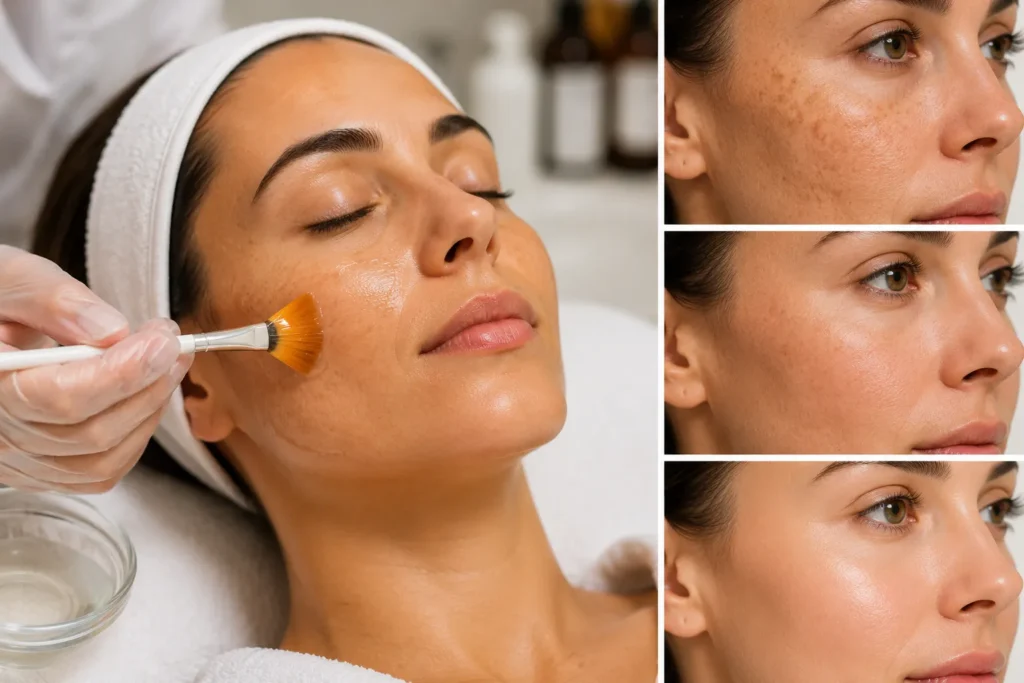
A chemical peel applies a solution that loosens and removes the skin’s outer layers. Our chemical peel treatment uses a solution that can be built on different acids, and the choice depends on the concern being treated and the depth of the peel.
Once the surface cells let go, your skin sheds them over the following days. That can be fine, dust-like flaking or something more visible. It is not damage to push through. It is the old surface leaving so newer skin can show, and how much of it you see is largely a function of peel depth.
Peel Depth Sets the Timeline
Peels fall into three broad groups: superficial, medium, and deep. Deeper peels carry more downtime and a higher risk of complications. The table below summarizes what the American Academy of Dermatology describes for peels performed by dermatologists, using their chemical peel FAQs as the source.
| Peel depth | Typical healing (AAD) | What you may see |
|---|---|---|
| Light or “lunchtime” | 1 to 7 days | Redness, then scaling once it fades |
| Medium | 7 to 14 days | Redness and swelling, then crusting before peeling |
| Deep | 14 to 21 days | Bandaging and several follow-up visits |
If a friend recovered for two weeks, they very likely had a stronger peel than the one you are planning. The rest of this guide is written mainly with lighter peels in mind, which is what most people picture when they book. Your provider will confirm what applies to your own treatment.
Why AFA Peels Usually Mean Lighter Flaking
Conventional glycolic or TCA peels work by dissolving the bonds that hold the surface layer on, which can pull moisture out along with it. That is where the stinging, tightness, and sheet-like shedding tend to come from.
An AFA peel is built on amino acids, which are water-loving, so it is designed to hydrate the dead layer before lifting it. The realistic version is light flaking around the nose and chin rather than the sheeting people imagine. The trade-off is honest: a single AFA peel does less in one sitting than a strong TCA peel, which is why tone changes build across a course.
Chemical Peel Peeling Stages, From First Flush to Fresh Skin
Treat the stages below as a map, not a stopwatch. The example here is You Glow’s AFA (amino fruit acid) peel, which our clinics describe as lighter on the skin than a conventional strong-acid peel. Flaking windows differ slightly from clinic to clinic, so your own clinic’s guidance should lead.
| Stage | What you may notice | What helps |
|---|---|---|
| Treatment day | Mild tingle or warmth, then a slight flush that settles within the hour | Gentle cleanser, bland moisturizer, sunscreen |
| First day or two | Pinkness and tightness, a bit like mild windburn | Rich moisturizer, no actives |
| Flaking window | Light flaking around the nose, mouth, and chin, over roughly two to five days | Do not pick; keep the routine bland |
| Shedding finishes | Skin looks brighter and smoother once the flaking ends | Daily sunscreen, no exfoliants yet |
Not everyone flakes much. At a gentle strength, many people barely peel at all. Several things shift your own timeline:
- The strength your provider chooses on the day.
- Your skin type and how dry or reactive it is that week.
- What you use at home, and how closely you follow aftercare, including sun protection.
Once shedding is done, it is tempting to book the next session early. Pigment and texture concerns are usually worked on across a series of peels rather than in one visit. For tone concerns, some of our AFA clinic pages describe four to six peels roughly two to four weeks apart, then occasional maintenance, while others suggest about four weeks between peels. Your plan is set at consultation.
Worried About How Visible Your Peeling Will Be?
Peeling is easier to plan around when you know your strength in advance. Your esthetician can talk you through what to expect for your skin, your calendar, and any events coming up.
Have your dates and your flaking questions ready, then ask about peel strength and timing for your calendar, and we will help you choose a sensible plan.
Normal Peeling or Time to Call Your Clinic?
Most of what you will see fits a familiar pattern. When something does not, it is better to ask than to guess. The American Academy of Dermatology advises contacting your dermatologist if treated skin burns, itches or swells.
| What you notice | Usually fits the pattern? | What to do |
|---|---|---|
| Pinkness that fades over a day or two | Yes | Keep routine bland |
| Tight, dry feeling | Yes | Rich moisturizer |
| Fine flaking near the nose, mouth, and chin | Yes | Let it shed on its own |
| Burning, itching or swelling | Not expected | Contact your clinic or dermatologist |
| Urge to scratch or pick | Common, but avoid | Leave skin alone; ask if worried |
Rubbing or scratching treated skin can lead to infection, and a persistent concern is worth a conversation with your doctor.
How to Care for Skin While It Peels
Most of the aftercare is simple. The hard part is leaving your skin alone.
- Do not pick, peel, or scratch. Lifting flakes early is how people end up with marks.
- Keep it bland. Use a gentle cleanser and a rich moisturizer, with nothing active until your provider says it is time.
- Skip heat and sweat for 48 hours. That means hot showers, saunas, heavy workouts, and swimming.
- Wear broad-spectrum sunscreen daily. Glare off winter snow counts.
- Ask about makeup. Our national guidance is to wait until your skin heals, though your clinic may allow it sooner after a gentler peel.
Our national guidance also says to skip exfoliants, vitamin C, and retinoids for 7 to 10 days or until peeling completely stops. If you are peeling in winter, our guide to AFA peel aftercare in cold weather covers wind, dry indoor heat and scarf friction.
Getting Ready: What to Do Before a Peel
What happens before your appointment influences what happens after it. Our national guidance asks clients to stop retinoids, AHAs, BHAs, and prescription acne creams 5 to 7 days beforehand, avoid unprotected sun, tanning beds, and sunburn for at least a week, and skip waxing, threading, and shaving the face for 48 hours.
Mention cold sores, recent facial treatments, new medications, pregnancy, active irritation or open skin, so your provider can decide whether a peel suits you right now. Our pre-care and aftercare guide shows how preparation and follow-through protect results.
Where to Book an AFA Chemical Peel
AFA peel pages exist for Winnipeg, Ottawa, Red Deer, Calgary SE, and Calgary NW. At other clinics, availability varies, so please confirm when you book.
The strength is chosen at your appointment, so plan with your clinic rather than relying on a fixed menu. Results vary with skin type, strength, number of sessions, sun exposure, and how closely you follow aftercare.
Frequently Asked Questions
Is it normal if my skin barely peels?
Yes, it can be. At a gentle strength, many people barely peel at all, so little flaking does not automatically mean the peel did nothing. Brightness and smoothness are separate from visible shedding. If you are unsure how your skin is responding, your clinic can look at it with you.
Can I work out or use a sauna while my skin is peeling?
Not right away. Our guidance is to avoid hot showers, saunas, heavy workouts and swimming for 48 hours after a peel to prevent irritation. After that, listen to your skin, and keep sunscreen on for outdoor exercise. Ask your provider if flaking continues and you are unsure.
Why shouldn’t I pick at flaking skin?
Picking lifts skin that is not ready to come off, which is how marks happen. The American Academy of Dermatology also notes that rubbing or scratching peeled skin can lead to infection. Let flakes shed on their own, moisturize gently, and message your clinic if something worries you.
How long should I wait before my next peel?
It depends on the peel and your plan. For AFA courses, some of our clinic pages describe sessions two to four weeks apart, while others suggest about four weeks. The American Academy of Dermatology describes repeating light peels every few weeks. Your provider sets the spacing at consultation.
Can I have a peel before a wedding or event?
Plan it well ahead. Light flaking can show for roughly two to five days, and you will not want that the day before a big event. Tell your esthetician the date at your consultation, and they can suggest timing that leaves room for your skin to settle.
Plan Your Chemical Peel With Confidence
Knowing the stages takes much of the worry out of peeling. The rest is choosing a strength and timing that suit your skin and your calendar, whether that means working around a trip, an event or simply a busy week.
If you would like to talk it through, map out your peel plan with a free consultation, and we will build a schedule that feels comfortable from the first appointment to the fresh-skin finish.