About the treatment
The appointment is the trigger. The result is what your skin does next.
Most treatments hand you a result on the day and then it fades. This one hands you almost nothing on the day and then keeps giving for three months. Understanding that inversion is most of what you need to know before booking.
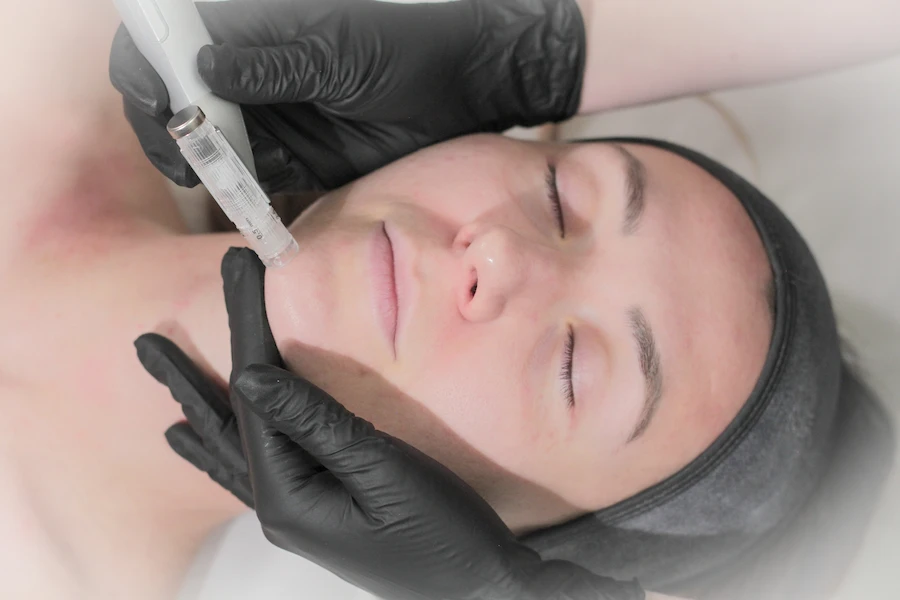
A powered pen carries a cluster of very fine sterile needles and drives them in and out of the skin at speed, making thousands of microscopic channels with every pass. Each channel is narrow enough to close within hours. Nothing is taken out and nothing is put in.
What the needles do is convince your skin that it has been injured. That is not a side effect, it is the entire purpose. Skin only lays down new collagen when it thinks it is repairing something, so the treatment manufactures a repair job small enough to be trivial and widespread enough to be worth responding to. The response runs for weeks: growth factors first, then new collagen and elastin, then months of that new material reorganising itself into something that holds a shape.
Which means the honest answer to “when will I see it” is not the week after. There is a pleasant glow in the first few days that comes from swelling and circulation, and then it settles and you may conclude nothing happened. The structural change arrives somewhere between two and three months later, and it arrives whether or not you were paying attention.
Why we reach for it so often here
The one collagen treatment that does not ask what colour you are
In a city this mixed, that sentence does a lot of work. A great many resurfacing treatments have to be limited, adjusted or declined depending on natural skin tone. Microneedling does not.
Light-based treatments work by being absorbed more by a target than by the skin around it, so as natural tone deepens the safety margin narrows and eventually closes. That is a real constraint and we apply it honestly on our pulse light pages. Needling has no such mechanism. It is not looking for pigment; it is making a physical channel, and a channel behaves the same in every skin.
There is still a rule, and it is about inflammation rather than the treatment itself. Skin that produces pigment readily also produces pigment in response to inflammation, so an overly aggressive session or a sunburned fortnight afterwards can leave darkening where you wanted evenness. The answer is not to avoid the treatment; it is to run it at a sensible depth, space the sessions properly and take the two weeks of sun discipline seriously. Done that way it is one of the safest options we have for deeper tones, which is exactly why it is often our recommendation on Wynford Drive.
Why here
Fitting a course into a Toronto year
The treatment is the easy part. Running a course properly across twelve months in this city takes a little planning.
Sunscreen is the whole of the aftercare
Two weeks of real protection after each session, every session. Southern Ontario runs a higher summer ultraviolet index than most people here expect, and a patio afternoon on day four is how an evening-out result becomes an uneven one.
Tower air does not help the healing days
Offices around Don Mills and Eglinton run on recirculated, heated or chilled air that is drier than outside in either season. A barrier that is rebuilding holds water badly to begin with, so the flaky stage lasts longer at a desk than it does at home. A plain occlusive balm for two days fixes it.
Count back a fortnight from anything that matters
You look flushed for a couple of days and slightly flaky for a couple more. That is all manageable, but it is not what you want in wedding photographs. Bring your dates to the consultation and we will place the sessions between them.
A winter start is the sensible one
A course sits weeks apart and the result lands months after the last session. Beginning in the low-light half of the year means the sun discipline is easy and the finished result appears around the time you would like it to.
Indications
What is it good for?
Anything where the shape of the skin is wrong rather than its colour. If a fingertip can find it, needling is in the conversation.

Flat brown marks and thread veins are colour, and belong with pulse light. Congestion and blackheads clear faster with a hydro facial. Oil and visibly large pores on their own often respond better to a carbon peel. The full North York menu is on the Toronto clinic page.
Choosing between them
Microneedling or red light therapy
Both are sold as collagen treatments and both are true to that. One provokes your skin hard and waits; the other coaxes it gently and repeats. The right answer usually comes down to what you are willing to look like for two days.
Microneedling
- Creates a repair response, deliberately and physically
- Strong enough to remodel scar tissue and pitting
- Two or three days of looking visibly treated
- A handful of sessions, weeks apart
- Judged at three months, not three days
Red light therapy
- Supports the cells that build collagen without injuring anything
- Will not change scarring, but improves tone and calms inflammation
- Nothing visible whatsoever afterwards
- Frequent short sessions, run as an ongoing habit
- Judged over months of consistency
If there is real damage to undo — scarring, pitting, a texture you can feel — needling is the only one of the two that will move it. If the skin is essentially sound and you want it supported without downtime, red light is the better habit. They combine well: red light in the weeks between needling sessions speeds the calm-down and is the pairing we suggest most often.
Getting ready
Pre & post treatment
Arrive with calm skin and leave it alone afterwards. Those two sentences cover most of it; the lists below are the detail.
Winding down beforehand
- A week out: retinol, prescription vitamin A and anything currently peeling you all come out of the routine.
- Three days out: no acids, no scrubs, no waxing or threading anywhere we are treating.
- A fortnight out: no other resurfacing appointment, in either direction, and no sunburn.
- At booking: raise cold sores, any tendency to keloid or raised scarring, active breakouts in the area, oral acne medication, and pregnancy or nursing.
Getting through the week after
- The first day: hot, tight and clearly red. Only what we send you home with goes on the skin, and no makeup at all.
- The second and third: pink turning blotchy, often with fine flaking. Mineral makeup is fine from here if you need it.
- Forty-eight hours: nothing that makes you sweat — no gym, no sauna, no steam room, no hot yoga.
- Fourteen days: sunscreen every single morning and no deliberate sun. On deeper skin tones this is the instruction that protects your result, not just your comfort.
Results
Microneedling before and after
A You Glow Aesthetics client treated for acne scarring across a course. Rather than hunting for individual marks, look at how the light now runs across the cheek without breaking up — the change is in the shape of the surface.
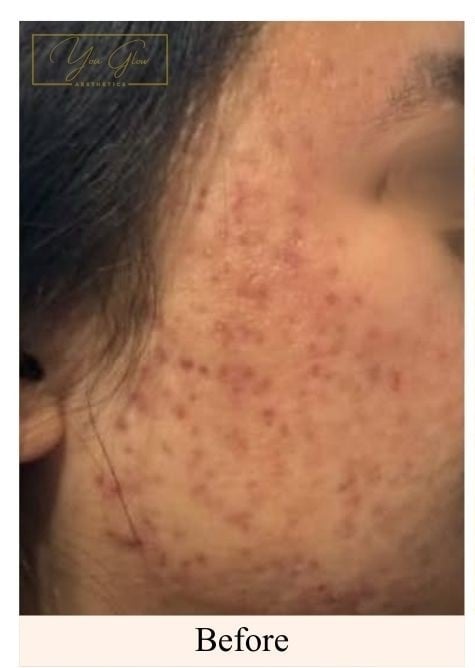
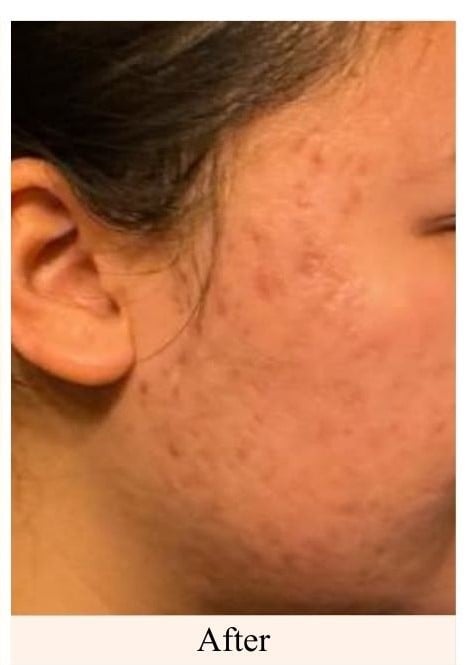
What any individual gets out of a course depends on the type and depth of the scarring, on age, on how many of the planned sessions actually happen, and on how well the skin is protected in between. Collagen keeps reorganising for months, so the fair point to judge is around three months after the final appointment.
Also on Wynford Drive
Treatments that work well around this one
- Red Light Therapy in Toronto — the no-downtime companion between sessions
- Hydro Facial in Toronto — for congestion, and a gentle option in the gaps
- Carbon Peel Facial in Toronto — for oil and visibly large pores
- Acne Facial (IPL) in Toronto — worth settling active breakouts before needling scars
- Microneedling across You Glow Aesthetics — how we run it at every branch
- Our Toronto clinic — hours, team and everything we run in North York