About the treatment
Brightening with light means removing, not adding
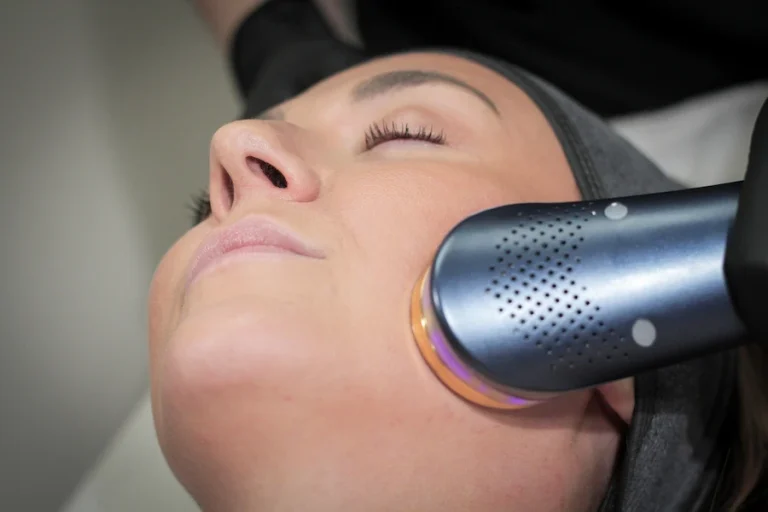
Most brightening products work by slowing the production of pigment. A brightening facial with pulse light works from the other end: it goes after the pigment that is already sitting there and gets the skin to shed it.
The energy is delivered as a broad band of light that passes through clear tissue and is absorbed by anything dark. A patch of melanin absorbs a great deal of it; the skin beside the patch absorbs very little. What the patch absorbs becomes heat, the cluster is disrupted, and the fragments are carried upward by ordinary skin turnover until they reach the surface and flake away.
Two consequences follow, and both are worth knowing before you book. The mark will look darker for several days before it looks better, which is the treatment working rather than going wrong. And nothing here stops you making new pigment, so the sunscreen habit decides whether the result lasts a season or several years.
Choosing between them
One session, or a course?
This is the question people actually want answered, and the honest reply depends on what you are treating rather than on what you can afford.
A single session is enough when
- You have a handful of discrete, hard-edged spots
- They are superficial and recent rather than decades old
- Your skin is fair and responds strongly
- You are content to repeat it in a year or two
A course is what it takes when
- The unevenness is spread across whole areas rather than spotted
- There is redness mixed in with the brown
- The pigment has been building for twenty years
- You want the tone to hold rather than to improve once
We will tell you which of those you are at the consultation, including when the answer is one session. Selling a package to somebody who needs a single appointment is the easiest money in this industry and we would rather not take it.
Why here
Two different reasons a Toronto face looks dull
They need different treatments, and telling them apart is the first thing we do. One of them is not a pigment problem at all.
Actual pigment, made in summer
Southern Ontario runs a higher summer ultraviolet index than most people here assume. Cottage weekends, the walk from the subway and patio season put real marks on cheekbones, temples and the bridge of the nose.
A grey film that is not pigment
Traffic particulate settles on the face, mixes with sunscreen and oil and sits on the surface. That scatters light and reads as dullness even on perfectly even skin. Pulse light will not touch it; a proper deep cleanse will.
Why both get called the same thing
Because in the mirror they look identical. A great many people book pigment treatment for a problem a hydro facial solves in an hour, which is an expensive way to be disappointed.
November to March is the treatment window
A course needs untanned skin at every session, and a Toronto winter provides that reliably. Booking in September, after a summer outdoors, usually means waiting.
Indications
What is it good for?
Uneven tone with a visible cause: sun spots, mottling and the marks left where acne healed.



If the dullness is a film rather than a mark, the hydro facial is the cheaper and faster answer. For oil and open pores, the carbon peel facial. Everything we run in North York is on the Toronto clinic page.
Being straight with you
Four things this does not do
Worth reading before you book anywhere, not only here.
It does not lighten your skin
Nothing on this menu is aimed at changing your overall colour, and we do not offer anything that is. The light finds dark clusters and leaves the tissue around them alone. What changes is the unevenness.
It is not safe on every skin tone
Pulse light cannot distinguish the pigment it is meant to target from the pigment evenly present in your skin, so as natural tone deepens the margin narrows and the risk of a burn or a pale patch rises. In a city this diverse that is a conversation we have constantly, and there are other routes to the same result.
It is usually wrong for melasma
Soft-edged, symmetrical, hormone-driven pigment can be aggravated by heat. If that is what you have, we will steer you towards a chemical route rather than light, and we would rather lose the booking than make it worse.
It does not prevent the next spot
Clearing what is there does nothing about what you make next summer. Without daily sunscreen a good result lasts one season, and that is not an upsell, it is arithmetic.
Getting ready
Pre & post treatment
Pigment work is easy to undo between visits, so the aftercare matters as much as the session.
Before each session
- Four clear weeks with no sun, no booth and no self-tan. A cottage weekend counts.
- Stop retinoids a week out and acids three days out.
- Tell us about hormonal changes — pregnancy or a change of contraception. Both drive melasma and both change the plan.
- Mention photosensitising medication and any history of cold sores.
Over the next fortnight
- The marks darken first. Day two is the worst it looks and it is meant to.
- Do not scrub or pick them off. Let the skin release them between day seven and fourteen.
- Sunscreen every single morning, reapplied on bright days.
- Nothing hot for 48 hours, and no actives for five days.
Also on Wynford Drive
Treatments that work well around this one
- IPL Facial in Toronto — the broader photofacial, redness included
- Hydro Facial in Toronto — for the dullness that is film rather than pigment
- Carbon Peel Facial in Toronto — for oil, open pores and a rough surface
- Dermaplaning in Toronto — surface smoothing between light sessions
- Our Toronto clinic — everything we run in North York