About the treatment
Your immune system does the removing. We make it possible.
A tattoo is permanent for a mechanical reason rather than a chemical one. The pigment particles are simply too large for the cells that patrol your skin to pick up and carry off, so they sit where the needle put them, decade after decade.
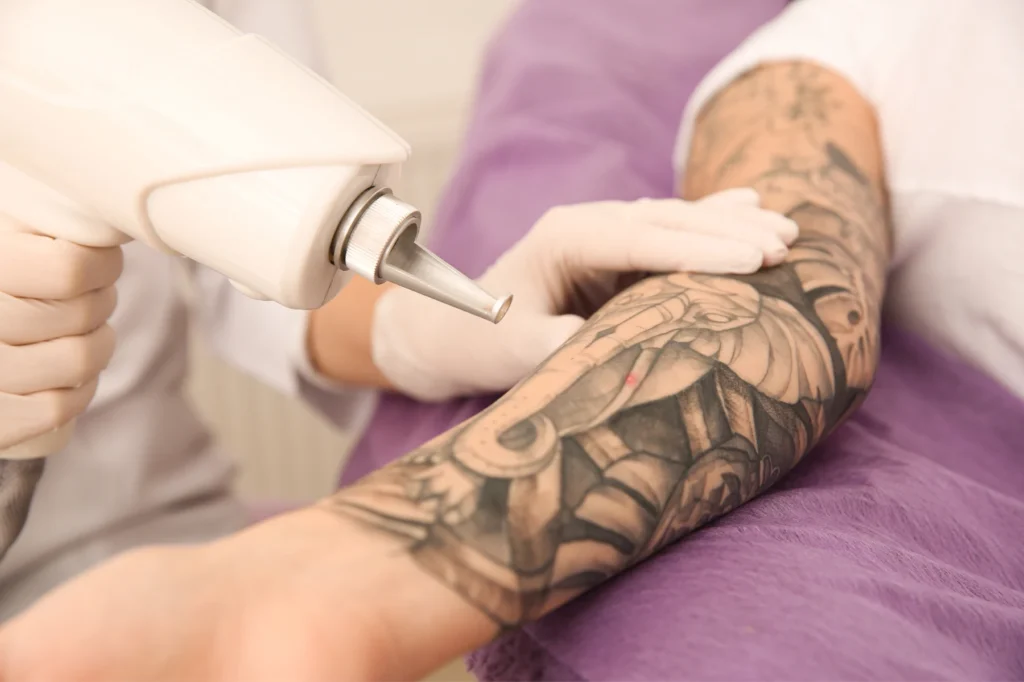
Light changes that. A pulse of energy is absorbed by the pigment, heats it faster than it can dissipate and breaks the particles apart. What is left is small enough to be collected and drained away through the lymphatic system over the following weeks, which is where the fading you eventually see comes from.
So the appointment is short and the result is slow, and there is nothing anyone can do to change that ratio. At our Wynford Drive clinic in North York the first visit is a consultation with the tattoo in front of us — ink, depth, age and placement vary so much that anything said from a photograph is a guess dressed up as a quote.
The consultation
Why the first visit is a look rather than a treatment
We would rather spend a session working out what we are dealing with than start firing and find out afterwards.
What we are reading
Ink colours and how many of them, how densely the piece is packed, how deep the artist went, how old it is, whether anything has been layered over anything else, and where on the body it sits. Each of those moves the number of sessions.
A test spot first
On a small area we can see how your skin and your particular ink respond before committing to the whole piece. On deeper skin tones this step matters twice over, because the goal is to remove pigment from the tattoo without disturbing the pigment in you.
A range, then a revision
You leave with a realistic range rather than a promise. After two sessions we know how your body is clearing, and the estimate is corrected to match what is actually happening rather than what we hoped.
Want a straight answer about your tattoo rather than a generic one?
What decides the outcome
Colour matters more than size
A large black piece is often easier than a small multi-coloured one. This is the part clients are most often surprised by, so it is worth setting out properly.
Black and dark blue: the cooperative ones
They absorb energy across a wide range of wavelengths, which means they break up readily and clear the most predictably. Most of the results people have seen online are black ink, and that is not an accident.
Green and turquoise: the slow ones
These sit at the awkward end of the spectrum and shift grudgingly. A piece with a lot of green in it will need more patience than the same piece in black, and you should hear that at the start rather than at session five.
Red, orange and purple: it depends
Behaviour varies with the specific pigment the artist used, and there is no way to know that in advance. Some respond well. Others barely move. The test spot is how we find out rather than guessing.
White and flesh-toned ink: the trap
Some pale inks contain compounds that can darken rather than fade when heated. That is why we test before treating any piece containing them, and why a cover-up in skin tones needs a particularly careful look before anyone switches a laser on.
Indications
What is it good for?
Four different jobs, and only the first of them is taking a tattoo all the way off.
Clearing it completely
The longest route, and a realistic goal for dark ink on an area with good circulation. It takes a full course and the patience to let each gap run its length, and we will keep revising the estimate as your skin shows us how it clears.
Fading it enough for a cover-up
The most common reason people walk in. Your artist does not need a blank canvas — only ink faint enough to design over — and that takes a fraction of the sessions full clearance would. Bring the proposed design with you.
Taking out one part of a piece
A name, a date, one panel of a sleeve. The energy goes where it is aimed, so an element can be removed while the work around it is left intact.
Restarting a course that stalled
Plenty of people arrive part-way through removal somewhere else, frustrated that the fading stopped. Often the intervals were too short or the remaining ink is a colour that needed a different approach. We will tell you honestly whether more sessions will move it.
Planning a cover-up and unsure how much fading your artist needs?
Why here
Running a long course through a Toronto year
Sessions sit six to eight weeks apart, so a course crosses every season at least once. Two of them are easy and two take some management.
The covered months are the productive ones
From October to April the treated area lives under sleeves, and keeping it out of the sun takes no effort at all. Most of our clients make their fastest progress across the winter for that single reason.
Humidity is kinder to healing than dry cold
One genuine advantage of a Toronto summer: skin that is not fighting dry air closes over more comfortably. The problem in July is not the humidity, it is everything you do in it.
Pools, lakes and sweat are the summer risk
Chlorinated water, a swim off the island and a hard session in a gym all reach a healing area that should be left alone for a couple of days. Book the session for a weekend you are not planning either.
Tell us about the February trip
A week somewhere hot mid-course is common here and entirely manageable — as long as we know. We will schedule around it rather than treat skin that has just come back with a tan.
Wondering whether now is a sensible time to start?
Getting ready
Pre & post treatment
Treat the aftercare as wound care rather than skincare. Following it is most of the difference between clean fading and a scar.
Before you come in
- Keep the tattoo covered from the sun for a month where you can, and at minimum for a fortnight. No sunbeds and no fake tan over it.
- Shave the area the day before if there is hair over the ink.
- Arrive with the skin clean and bare — no moisturiser, no oil, no perfume across the tattoo.
- Skip blood thinners for a day or two where your doctor is content for you to, to keep bruising down.
- Eat and drink properly first. People who come in on an empty stomach have a worse time of it.
The fortnight afterwards
- Expect it to look like sunburn: red, raised and warm. Blistering happens and is part of the process rather than a failure.
- Thin ointment, sterile dressing, gentle washing for the first few days, exactly as we show you on the way out.
- Whatever forms, leave it alone. Picking is the one thing that reliably turns a fading tattoo into a scarred one.
- Nothing submerged and nothing strenuous for two days — no pool, no hot tub, no sauna, no heavy training.
- Once it has closed, sunscreen over it every day until the next session, and keep drinking water: clearance is your lymphatic system doing the work.
Being straight with you
Three things that surprise people mid-course
It fades unevenly
Dense areas hold on while thin outlines vanish, so for a while the tattoo can look worse rather than better. That is normal and it evens out. Knowing it is coming is the difference between patience and panic.
Something may remain
Most dark tattoos end up faint or invisible. Some leave a shadow, a slight difference in texture, or a pale patch where heavily worked skin has healed differently. Anyone guaranteeing a blank canvas before seeing your ink is guessing.
It is a long commitment
Eight sessions at eight-week gaps is comfortably more than a year of your life. If there is a deadline behind this — a wedding, a new job, a holiday — say so at the consultation so we can tell you plainly whether it is achievable.
Regretting one and want to know what is realistically possible?
Also on Wynford Drive
Treatments that work well around this one
- Laser Hair Removal in Toronto — the same principle, aimed at pigment in the follicle
- Red Light Therapy in Toronto — supports the skin between sessions
- Carbon Peel Facial in Toronto — laser work for the face rather than for ink
- Hydro Facial in Toronto — unrelated to the ink, and our most-booked facial
- Laser tattoo removal brand-wide — how the treatment works across all our clinics