About the treatment
What scalp microneedling actually is
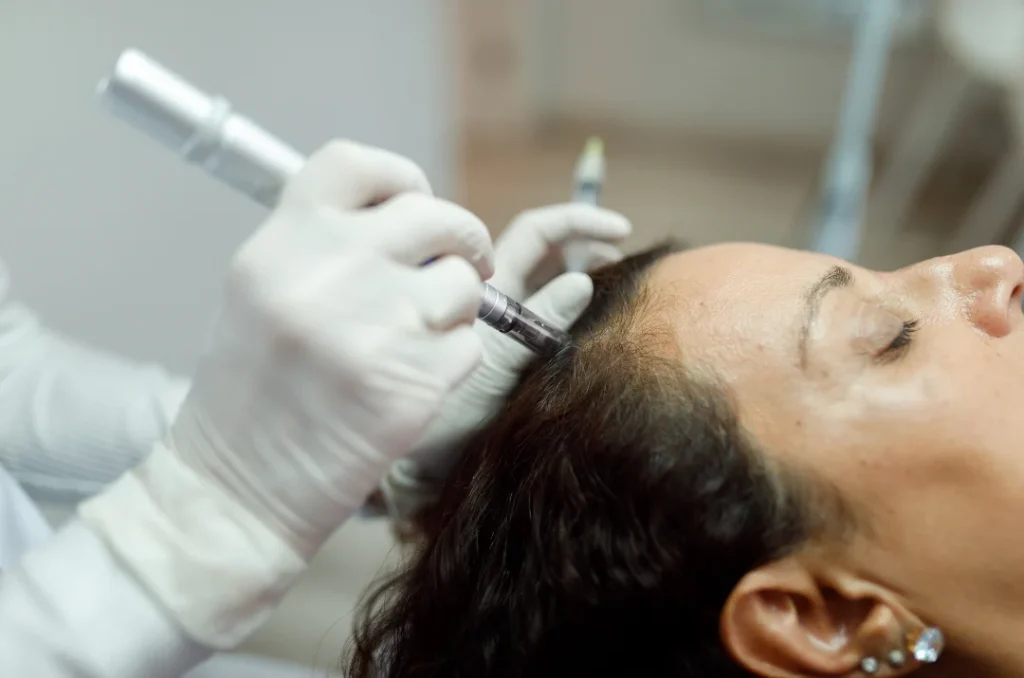
It is the same principle as microneedling for the face, applied to the scalp. Fine medical-grade needles create thousands of controlled micro-channels in the skin, and the healing response that follows is what the hair follicles benefit from.
A follicle is not a passive thing. It cycles through growing, resting and shedding phases, and what keeps it in the growing phase is blood supply and the growth factors that arrive with it. Thinning hair very often means follicles that have slipped into dormancy rather than follicles that have died — and a dormant follicle can be woken.
The micro-channels do two things at once: they trigger a rush of circulation and growth factors around the follicle, and they open a physical route for topical treatments to reach it instead of sitting on the surface of the scalp. At our clinic on McCarthy Road it is used for early-stage thinning, a widening part or a receding hairline — and it is not surgery, so there is nothing to recover from beyond a tender scalp for a day.
How it works
What it does to your scalp
Three mechanisms, all of them aimed at the environment around the follicle rather than at the hair itself.
01
Circulation increases
The healing response draws blood to the treated area, and blood is how a follicle receives everything it needs. Poor scalp circulation is one of the quieter contributors to thinning, and this addresses it directly.
02
Growth factors arrive
Micro-injury releases the same signalling molecules that drive repair anywhere in the body. Around a hair follicle those signals can push it back out of dormancy and into an active growing phase.
03
Topicals finally get in
If you use minoxidil or a growth serum, most of it never reaches the follicle. The channels give it a route down. This is why needling plus a topical routine tends to outperform either one on its own.
Noticed a wider part or more hair on the brush this year?
Who it suits
Is this the right treatment for you?
Hair restoration is a field with a lot of overselling in it. Here is an honest account of who this works for and who it does not.
Early-stage thinning — yes
A part that has widened over a couple of years, hair that has lost density, a hairline that has crept back. There are still live follicles there producing finer hair than they used to, and that is exactly what responds.
Already using minoxidil — yes
This is arguably the best case of all. The channels dramatically improve how much of the topical actually reaches the follicle, so the routine you are already committed to starts working harder.
Post-partum or stress-related shedding — usually
Shedding driven by a hormonal or stress event often recovers on its own, and improving circulation supports that. We would want to understand the timeline before recommending a full course.
A smooth, long-bald area — no
Where the follicle is genuinely gone there is nothing left to stimulate, and no amount of needling changes that. We will tell you at the consultation rather than sell you six sessions that cannot work.
Related reading: scalp health and dandruff and chronic dry scalp — both worth resolving before starting a course, since a healthy scalp is the ground this treatment works on.
Want to know whether your follicles are dormant or gone?
Why here
Scalp health through an Ottawa winter
The scalp is skin, and it takes the same beating from this climate that your face does — it just gets none of the attention.
Dry air, flaking and irritation
Months of indoor heating dry the scalp out, and an itchy, flaking scalp is an inflamed one. Chronic low-grade inflammation is not the environment a follicle grows well in, which is why we look at scalp condition before starting.
Hats and toques all winter
Five months of friction and trapped heat, often over hair that is washed less because of the cold. It is a combination that builds up product and oil at the root exactly where you least want it.
Seasonal shedding is real
Many people shed more in autumn. It is usually temporary, and it is also the moment people first notice thinning — which makes late autumn the most common time to start a course here.
The timeline suits the season
A course runs three to six months before you can fairly judge it. Starting in November means assessing the result in spring, with hats off and better light — which is when you will actually see it.
The difference
Clinical scalp needling or a home roller?
A derma roller at home
- Fixed shallow depth, whatever the scalp needs
- Rolls, so needles enter at an angle and drag
- Difficult to keep genuinely sterile between uses
- Easy to overdo, and an irritated scalp sheds more
Clinical scalp microneedling
- Depth set for scalp skin, which is thicker than facial skin
- Vertical stamping — clean channels, no tearing
- Sterile single-use cartridge every time
- Spaced three to four weeks apart, so the scalp recovers between
Infection risk is the part people underestimate. The scalp carries more bacteria and more oil than the face, and repeatedly perforating it with a roller that lives in a bathroom cabinet is a genuinely poor idea. The spacing matters too — needling more often than the scalp can recover from works against you.
Been rolling at home and seen nothing change?
Getting ready
Pre & post treatment
The aftercare here is mostly about keeping a freshly needled scalp clean, which is less obvious than it sounds when hair is in the way.
Before your appointment
- Wash your hair that morning or the night before — arrive with no hairspray, gel or dry shampoo.
- Pause minoxidil or any topical growth treatment for 48 hours beforehand.
- No colour or chemistry: no dyeing, bleaching or chemical treatments for at least a week before.
- Tell us: any scalp condition, open sores or recent hair treatments.
After your appointment
- Expect tenderness: mild redness and a tight feeling across the scalp, settling within a day.
- Do not wash for 24 hours, then lukewarm water and a gentle shampoo only.
- Hold the minoxidil for 48 hours — applying it into open channels stings badly.
- No sweat or heat: skip workouts, hot showers and saunas for 48 hours to keep the scalp clean.
- Cover up outdoors: a loose, clean hat — a healing scalp burns very easily.
Ready to do something about it while the follicles are still there?
Also at our Ottawa clinic
Treatments that work well around this one
- Microneedling in Ottawa — the same technology applied to facial skin
- Anti-Aging Red Light Therapy in Ottawa — improves circulation and calms an irritated scalp
- Hydro Facial in Ottawa — for the face, and easy to book alongside a scalp session
- Everything at our Ottawa clinic — the full treatment list, hours and directions
- Scalp microneedling brand-wide — how the treatment works across all our clinics