About the treatment
The laser breaks the ink. Your body removes it.
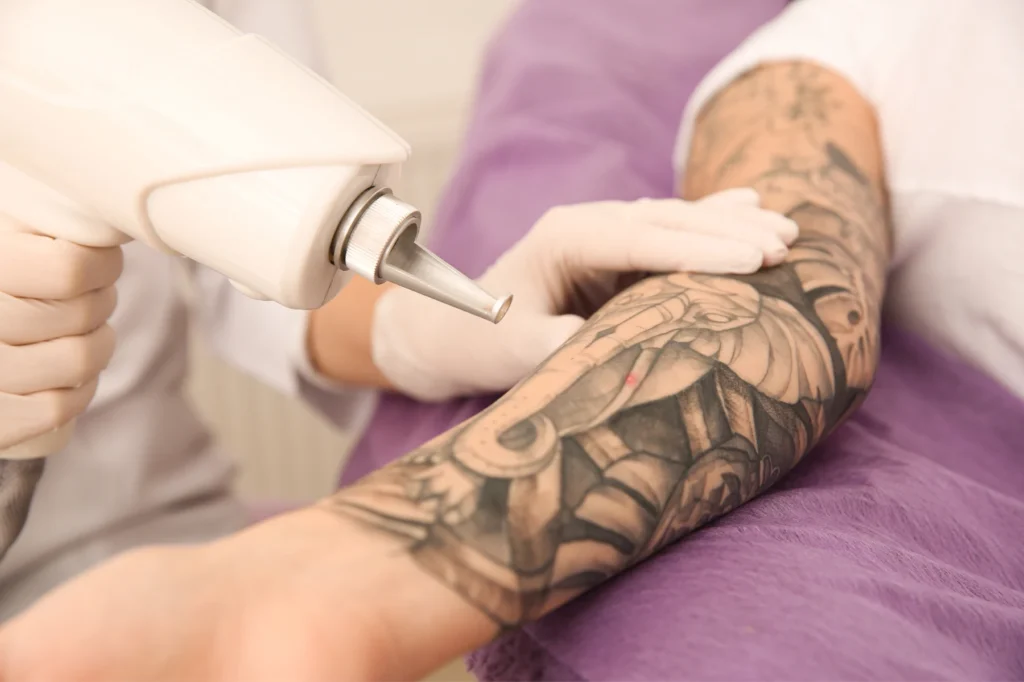
Tattoo ink sits in particles too large for your immune system to carry away, which is why a tattoo stays put. A pulse of light is absorbed by those particles, heats them in a fraction of a second and shatters them into fragments small enough to be collected and cleared.
That second half is the part people underestimate. The appointment takes minutes; the removal takes weeks, and it is done by your own lymphatic system rather than by anything in the room. It is also why the tattoo keeps fading long after you have left.
Nothing is cut and nothing is abraded, so the outcome is fading rather than a wound. At our Macleod Trail clinic in south Calgary the first appointment is a consultation with the tattoo in front of us, because ink, depth and age vary so much that anything said before seeing it is guesswork.
The schedule
Why the gaps are so long
Six to eight weeks between sessions, sometimes more. Clients often want to compress that, and there is a reason we will not.
The session
Minutes for a small piece. The area is cooled, the laser passes over the ink and the treated tattoo goes white for a short while — a normal response as gas is released in the skin — before settling to redness and swelling.
The fortnight after
The skin closes and settles. Some people blister, which is unwelcome but not a complication as long as nothing is picked. Almost no visible fading yet, which is where clients start to worry unnecessarily.
Weeks three to eight
The fragments are carried away and the tattoo lightens steadily. This is where all the progress happens, and treating over the top of it just puts energy into skin that is already busy.
Want a realistic picture of how long yours would take?
What decides the outcome
Four things about your tattoo that matter more than the machine
Two tattoos of the same size can need very different courses. These are the variables we assess before quoting you a number of sessions.
Colour
Black and dark blue absorb across the widest range of wavelengths and clear the most reliably. Greens and light blues are stubborn. Some yellows and whites barely respond at all. A multi-coloured piece will not fade evenly, and knowing that in advance prevents disappointment halfway through.
Age and who did it
Older tattoos have already been partly cleared by your immune system and start from a lighter place. Amateur and stick-and-poke work usually sits shallower and with less ink, so it often needs fewer sessions than a dense professional piece.
Where it is on you
Circulation drives the clearance, so tattoos closer to the heart fade faster. Chest and upper back tend to move quickly; ankles, feet and hands are the slowest areas on the body and take patience.
Density and layering
Heavy black shading and cover-up work over an older tattoo mean more ink in the same area, sometimes at more than one depth. That is more sessions, and we would rather say so at the start.
Indications
What is it good for?
Four reasons people book, and only one of them is complete removal.
Getting rid of it entirely
The longest road, and realistic for dark ink on a well-circulated area. We will give you a session range at the consultation and revise it once we see how the first two respond, which is far more honest than a number promised in advance.
Lightening it for a cover-up
The most common reason people come to us. Your artist only needs the old ink faint enough to work over, and that takes a fraction of the sessions full clearance would. Bring the new design with you.
Removing part of a piece
The laser is targeted, so a name, a section of a sleeve or one element of a larger design can be treated while the rest is left untouched.
Fixing amateur work
Home and stick-and-poke tattoos are usually shallow and lightly inked. They are among the most satisfying to treat because the change per session is obvious.
Planning a cover-up and not sure how much fading you need?
Being straight with you
Three things worth hearing before you commit
Nobody can promise you a blank arm
Most dark tattoos fade to something faint or invisible; some leave a shadow or a slight change in skin texture. Any clinic guaranteeing complete removal before seeing your ink is guessing, and we would rather set the expectation properly.
It is uncomfortable
An elastic band snapping repeatedly against the skin is the description almost everyone reaches for. It is brief, cooling helps, and it is more tolerable than people fear — but it is not a spa treatment and we will not pretend otherwise.
This is a project, not an appointment
Eight sessions at eight-week intervals is well over a year. If you have a deadline — a wedding, a job, a holiday — tell us at the consultation so we can be honest about whether it is achievable.
Regretting one and want to know what is realistic?
Getting ready
Pre & post treatment
The aftercare here is closer to wound care than to skincare, and following it is the difference between fading and scarring.
Before your session
- Keep the tattoo out of the sun for two to four weeks. No tanning beds and no self-tanner over it.
- Shave any hair over the area the day before.
- Nothing on the skin: no cream, no oil, no perfume, no make-up over the tattoo.
- No aspirin, ibuprofen or blood-thinning supplements for a day or two, to keep bruising down.
- Eat beforehand and come hydrated. It makes the session easier.
The days that follow
- Redness, swelling and a sunburn feeling are expected. Blisters can form and are part of healing.
- Wash gently with mild soap, then a thin layer of the ointment we give you under a sterile dressing for the first three days.
- Do not pick, scratch or pop anything. This is the single instruction that decides whether you scar.
- No pools, hot tubs, saunas or hard training for 48 hours.
- Cover it or use a high-SPF mineral sunscreen once the skin has closed, and keep doing so between sessions.
Why here
Running a course through a Calgary year
A course this long crosses every season, and two of them need planning around.
Winter is the easy half
Sleeves and covered skin make the sun rule effortless, and healing between sessions happens out of sight. Most clients get their fastest run of appointments between October and April.
Summer needs discipline
Treated skin must stay out of the sun, and a Calgary July does not make that easy. It is workable with clothing and sunscreen, and it is the reason some clients pause a course over the hottest weeks rather than treat a tanned area.
Dry air slows healing
Skin that is short of moisture closes more slowly. Keeping the treated area covered and lightly moisturised once the ointment stage is over matters more here than in a humid climate.
Hydration is not filler advice
Your lymphatic system does the actual removal, and it works better when you are properly hydrated. It is the one thing you control between appointments that genuinely affects the result.
Ready to start, or just want to know what it would involve?
Also on Macleod Trail
Treatments that work well around this one
- Laser Hair Removal in Calgary SE — the same technology, aimed at pigment in the follicle
- Microneedling in Calgary SE — for texture left behind once the ink has gone
- Red Light Therapy in Calgary SE — supports the skin between sessions
- Carbon Peel Facial in Calgary SE — laser work for the face rather than for ink
- Laser tattoo removal brand-wide — how the treatment works across all our clinics