About the treatment
What thinning actually is, before we talk about treating it
Most people describe losing hair. What is usually happening is subtler and more hopeful than that: the follicles are still there and still working, but each cycle produces a shaft slightly finer, shorter and lighter than the one before. The count has barely changed. The hair has simply been shrinking, year on year, until the scalp starts showing through.
That process has a name — miniaturisation — and the important part is that a miniaturised follicle is alive. It is under-supplied and under-stimulated rather than closed, which means there is something to work with. A follicle that has genuinely shut down is a different situation and no treatment reopens it.
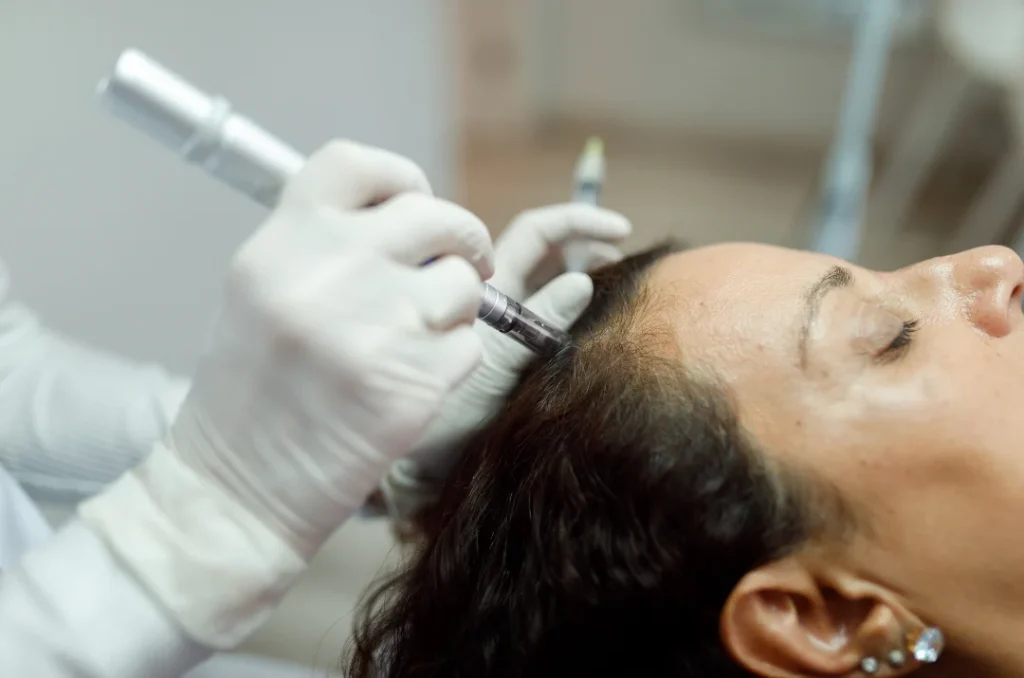
Scalp microneedling targets the first case. Fine sterile needles open thousands of temporary channels across the scalp, and your body responds to each one with blood flow, growth factors and cell signalling delivered straight to the tissue around the follicle. Numbing cream goes on first at our Timberlands Drive clinic in Red Deer, because the scalp is considerably more sensitive than the face.
The timeline
Three months before you judge anything
Hair grows roughly a centimetre a month, and nothing about this treatment can move faster than that. Understanding the schedule is most of what stops people giving up too early.
Weeks one to six
Nothing visible whatsoever. The stimulation is happening beneath the surface and any new growth it triggers has not reached the outside world yet. This is where most people quietly decide it is not working.
Months two and three
New hairs emerge, short and fine, and are easiest to see along a parting or a hairline under direct light. They will not look impressive. They are the whole point.
Months four to twelve
Those hairs lengthen and thicken while later sessions recruit more behind them. Density builds slowly enough that only a photograph taken at the start will convince you, which is why we ask for one.
Prepared to give something the better part of a year?
Why here
What a Red Deer year does to a scalp
Scalps get almost no attention in anybody’s routine, and around here they take more punishment than most people realise.
Something on your head for six months
A hard hat through a shift, a toque from November to April, a helmet at the weekend. Constant pressure, friction and trapped moisture on skin that is already dry, and nobody moisturises a scalp.
Indoor heat strips it
Forced air for months on end pulls moisture out of the scalp exactly as it does the face, and a dry, tight, flaking scalp is a poor environment for a follicle already producing weaker hair.
Sun where people never apply sunscreen
A thinning crown gets full exposure through a summer working outside, and almost nobody protects it. Damage accumulates in the one place where it directly affects the follicles you are trying to support.
Six to eight appointments, four to six weeks apart
Most of a year. For anybody driving in from the county that is worth planning out at the start — we are open seven days, which usually makes it manageable.
Indications
What is it good for?
Four situations where we would say this is worth your money, and the concern tiles elsewhere on our site do not cover hair, so here they are written out.
A parting that keeps widening
Usually the first thing anyone notices and usually the best time to start. Density along a parting tends to respond more readily than anywhere else on the scalp.
Thinning at the crown
The part you cannot see and everybody else can. Photographs from above at the start are essential here, because there is no way to assess progress in a bathroom mirror.
Hair that has lost its body
The count is much the same; the individual strands are simply thinner and softer, and the overall effect is a head that reads as sparse. That is miniaturisation described in ordinary language, and it is the target.
Getting more from a topical you already use
Open channels let far more of a product reach the depth where it does something. For a lot of clients this is the single strongest argument for booking.
Been using something for months with nothing to show for it?
Being straight with you
Three things we are not
Hair loss attracts more dishonest marketing than anything else in this industry, so it is worth stating our limits clearly.
We cannot tell you why it is happening
Thyroid problems, iron deficiency, hormonal conditions and a long list of medications all cause hair to thin, and we are not qualified to diagnose any of them. If you have not had it looked into, do that alongside rather than instead.
We are not a replacement for medical treatment
Where there is a prescription route that suits you, this works well beside it and poorly in place of it. The clients who do best here are generally the ones doing both.
We are not a finish line
Whatever you gain has to be maintained. After a course most people continue with an occasional session and their topical, and stopping everything usually means drifting back over the following year.
Want an honest assessment before you spend anything?
Getting ready
Pre & post treatment
Arrive with the scalp properly washed. Give it a gentle few days once you leave.
Before the appointment
- Shampoo on the day of the appointment, and leave everything else out afterwards: no serum, no powder, no wax, no spray.
- Skip a day of whatever you apply, minoxidil very much included. We will say when to pick it up again.
- Keep off anything that thins the blood for the preceding couple of days if that is possible for you. It keeps the pinpoint bleeding down.
- Declare anything going on with the skin up there. Psoriasis, eczema or an infection can all mean we reschedule you.
- Build in a bit of slack — the numbing needs a while to work before anything starts.
The days after
- Pink, warm and slightly tender for about a day, with some pinpoint marks. Both normal.
- Leave it unwashed for the first day. After that, something mild and a light touch.
- Nothing chemical on your hair for seven days — no dye, no lightener, no straightening.
- Two days without working up a sweat, and nothing sitting on your head in the meantime, work gear included.
- Protect it from sun and from glare off snow. A treated scalp burns faster than the temperature suggests.
At the consultation
The questions we will ask you
Worth thinking about before you come in, because the answers change whether we recommend this at all.
How long has it been going on?
Gradual thinning across years behaves very differently from hair that came out over three months following an illness, a birth or a period of real stress. The second often recovers by itself, and we will say so.
Is the scalp smooth, or is there still fine hair on it?
Fine, short hair means live follicles and something to stimulate. Skin that has been genuinely smooth for years means the follicle has closed, and no number of sessions reopens it.
What have you already tried?
Bring the bottles. Whether you are using a topical, for how long and how consistently, changes both the plan and the realistic expectation more than anything else you could tell us.
Has anybody investigated the cause?
A blood test that rules out the common medical causes is worth having before starting a year-long course. We will treat you either way; we would just rather you knew.
Ready to find out whether your scalp is worth treating?
Also on Timberlands Drive
Treatments that work well around this one
- Microneedling in Red Deer — the same technology applied to facial skin
- Red Light Therapy in Red Deer — supports circulation and settles the scalp between sessions
- Hydro Facial in Red Deer — frequently slotted into the same appointment during the numbing wait
- AFA Chemical Peel in Red Deer — resurfacing, where the concern is the face rather than the scalp
- Scalp microneedling brand-wide — how the treatment works across all our clinics