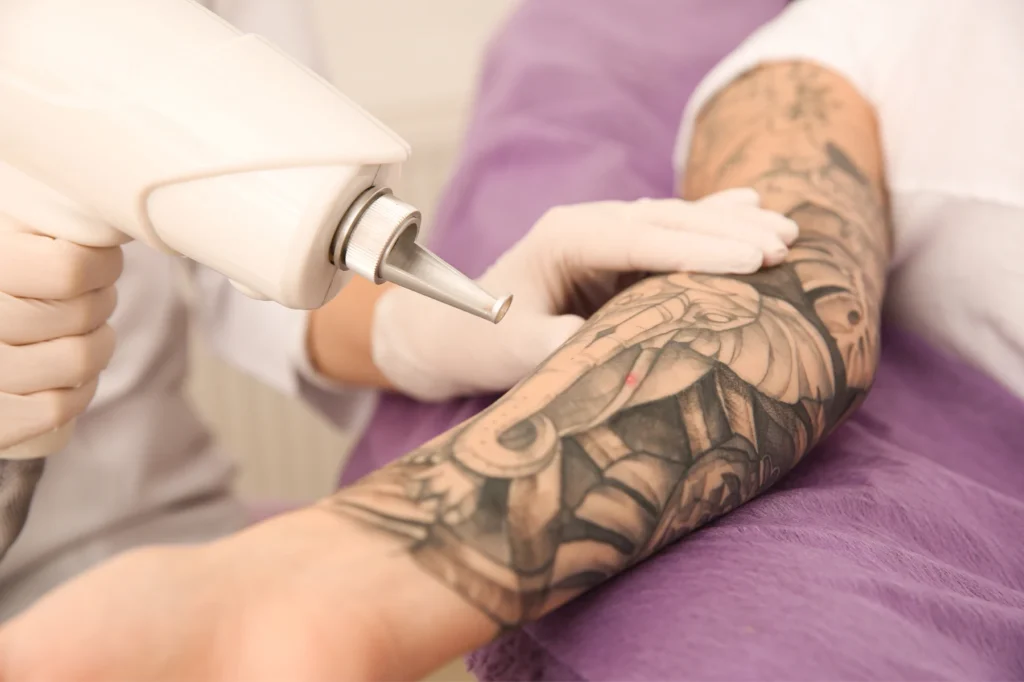
You have a tattoo you no longer love and a clear idea of what could go over it, but your artist says the old piece is too dark or too dense to cover as it stands. Partial fading may help lighten the old ink so the new design has room to work.
This guide will help you decide whether fading for a cover-up is the right goal, what to settle with your artist first, and what to expect from the process. It is a different project from removing a tattoo entirely, and knowing that can save you sessions and disappointment.
Key Takeaways
- Fading for a cover-up and full removal are different goals, and the first usually needs less clearance.
- Speak to your tattoo artist before booking, so you know how faint the old ink needs to be.
- Sessions are spaced roughly six to eight weeks apart at the Toronto and Calgary SE clinics, because the fading happens in your body between visits.
- Colour, age, placement, and density change how quickly a tattoo lightens, and nothing is guaranteed.
Fade or Erase? Know Which Goal You Are Planning For
Fading for a cover-up asks for less than full clearance. The old ink only needs to be light enough that a new design can be drawn and tattooed over it. Your artist does not necessarily need blank skin.
That said, nobody can tell you in advance how many sessions it will take or how much a given tattoo will lighten. Anyone promising a precise outcome before seeing your ink is guessing.
| Goal | What it asks of the ink | What to know |
|---|---|---|
| Fade for a cover-up | Faint enough for an artist to design over | Described as a fraction of the sessions full clearance would take; bring the new design |
| Clear it completely | As little remaining as possible | The longest route, described as realistic for dark ink on an area with good circulation |
| Remove one part of a piece | A name, date or one panel treated while the rest stays | The energy goes where it is aimed, so an element can be targeted |
If you want the wider picture first, our guide to what to know about laser tattoo removal before you start covers the basics. This article stays with the cover-up angle.
Talk to Your Tattoo Artist Before You Book Fading Sessions
Artist first, fading second. Your artist knows what the new design needs underneath it, so one conversation can stop you fading more than necessary, or less. Questions worth asking:
- How light does the old tattoo need to be for the design you have in mind?
- Would a different design, size or placement work better over the existing ink?
- Which parts of the old piece, such as heavy outlines or dark shading, cause the most trouble?
- How long do they like skin to heal before tattooing over treated areas?
Both the Toronto and Calgary SE clinics encourage you to bring the proposed design to your consultation. That gives the team something concrete to work toward.
How Light Pulses Fade Ink Between Sessions
The treatment breaks the ink, and your body clears it. Our laser tattoo removal treatment uses pulses of light that are absorbed by the ink, breaking the particles into smaller fragments. Your body’s natural processes then gradually clear them, so fading shows over the weeks after a session rather than on the day.
The wording varies a little by clinic. Our Toronto clinic offers IPL tattoo removal, while the Calgary SE tattoo removal service and the national treatment description refer to laser. Ask which is used where you are booking.
| Phase | What happens | Why it matters |
|---|---|---|
| The session | A short treatment; the area is cooled and may go white briefly before redness and swelling | The appointment is quick, but this is not where fading shows |
| The fortnight after | Skin closes and settles; some people blister; little visible fading yet | Do not pick anything, as that is what decides whether you scar |
| Weeks three to eight | Fragments are carried away, and the tattoo lightens | This is where progress happens, so treating again sooner does not help |
This phase breakdown comes from the Calgary SE clinic. In both Calgary SE and Toronto, sessions are spaced six to eight weeks apart, sometimes more. Your clinic sets the exact plan at consultation.
Not Sure How Light Your Old Tattoo Needs to Be?
The honest answer sits between your artist’s design and your tattoo’s ink, and it is easiest to judge with both in front of someone. Bring a sketch or photo of your cover-up idea, and our team can assess the existing tattoo and talk through a realistic range.
Tattoo removal is available at the Toronto and Calgary SE clinics, and availability elsewhere varies, so confirm when you book. If you would rather start with an assessment than a guess, you can get your old tattoo looked at against your cover-up idea.
What Makes One Old Tattoo Fade Faster Than Another
Colour often matters more than size. A large black piece can be easier than a small multi-coloured one, and two tattoos of the same size can need very different courses. The table shows how You Glow’s clinics describe the main factors.
| Factor | Tends to respond more readily | Tends to be slower |
|---|---|---|
| Ink colour | Black and dark blue | Greens and light blues; some yellows and whites barely respond |
| Age and technique | Older tattoos; shallow, lightly inked home or stick-and-poke work | Dense professional pieces |
| Placement | Closer to the heart, such as chest and upper back | Ankles, feet and hands |
| Density and layering | Lighter, single-layer ink | Heavy black shading and existing cover-up work |
Skin tone matters too. Laser tattoo removal is generally described as more effective on lighter skin tones, and the Toronto team uses a test spot to see how your skin and ink respond, which matters even more on deeper skin tones.
One caution is worth flagging if your old tattoo contains white or flesh-toned ink: some pale inks can darken rather than fade when heated. That is why a test comes first. A multi-coloured piece may also fade unevenly.
What Happens at Your First Fading Assessment
The first visit is a look, not a blitz of treatment. At the Toronto clinic, the team reads the ink colours, density, depth, age, placement, and any layering. A small test spot lets them see how your skin and that ink respond before committing to the whole piece.
You then leave with a realistic range for the number of sessions, not a promise. The Toronto team revises that estimate once they see how your body clears after the first couple of sessions. If a wedding, holiday or booked tattoo date sits behind this, say so early so the team can tell you plainly whether it is achievable.
Prep, Healing and Honest Expectations
Aftercare here is closer to wound care than skincare. Before a session, You Glow suggests:
- Avoid direct sun, tanning beds and self-tanners on the tattoo for 2 to 4 weeks.
- Arrive with clean skin, free of lotions, creams, perfume or makeup over the tattoo.
- Shave any hair over the area 24 hours beforehand.
- Avoid aspirin, ibuprofen or blood-thinning supplements for 24 to 48 hours to reduce bruising risk, and check with your doctor first if you take them for a medical reason.
Afterwards, mild redness, swelling, blistering or a sunburn-like feeling can be part of healing. Wash gently with mild soap and water, keep the area covered with a thin layer of recommended ointment and a sterile bandage for the first three days, and never pick at blisters or scabs. Skip hot tubs, pools, saunas and intense workouts for 48 hours, then protect the area with clothing or a high-SPF mineral sunscreen once the skin has closed. For more on healing, see our concern page on post-treatment skin recovery.
A few things surprise people midway through a course, so it is better to hear them now:
- Fading can look uneven, with dense areas holding on while thin lines lighten first.
- Some tattoos leave a faint shadow or a slight change in skin texture.
- Discomfort is real. People often describe a rubber band snapping against the skin, which is brief, and cooling helps.
- Results vary with skin, ink, settings, sessions and aftercare, and nothing is guaranteed.
The Toronto and Calgary SE teams both note that covered months make the sun rule easier to follow, while summer takes more planning. Pregnancy, active skin irritation or infection, open wounds and certain medical conditions or medications are worth raising at the consultation. For how modern removal works in more depth, read how modern laser tattoo removal works.
Frequently Asked Questions
Does the old tattoo have to disappear before a cover-up?
Not necessarily. Your artist only needs the old ink faint enough to design over, and how faint depends on the new design, its size and its colours. That is why fading and full removal are separate goals. Ask your artist what they need, then bring that answer to your consultation so the plan matches it.
Does tattoo fading hurt?
There is some discomfort. Most clients describe it as a rubber band snapping against the skin, and the procedure itself is quick. Cool compresses and the post-treatment instructions help with temporary tenderness or warmth afterwards. It is not a spa treatment, but many people find it more manageable than they feared.
Which tattoo colours fade most easily?
Black and dark blue ink typically respond best. Greens and light blues tend to be stubborn, and some bright colours may need more sessions to fade significantly. Some pale and flesh-toned inks can darken when heated, which is why a small test spot comes first. A multi-coloured tattoo may not fade evenly.
How long should I wait before tattooing over faded skin?
There is no single number, and your tattoo artist has the final say. Ask them how long they want the skin to settle after your last session before they work over it, and check in with them as the old ink lightens. Your clinic can tell you where your skin is in its healing, but the artist decides when it is ready.
Why are sessions six to eight weeks apart?
The light only breaks the ink into fragments, and your body does the clearing over the following weeks. At the Toronto and Calgary SE clinics, sessions are spaced roughly six to eight weeks apart, sometimes more. Booking sooner does not speed things up, because the skin is still busy clearing the last session.
Plan Your Tattoo Cover-Up Fading With Our Team
Whether your cover-up is months away or already booked in with your artist, a clear assessment makes the plan easier. You can also browse our before and after gallery, keeping in mind that every tattoo and every skin type is different.
When your design is chosen, ask the team to map out your fading timeline and bring your artist’s notes with you. Our estheticians will assess the tattoo and talk through a realistic range, with no pressure to commit.